News from the Nodes
Pacific Northwest Node
 Node Co-Investigator Andrew Saxon, MD Receives Gary J. Tucker Career Teaching Award Node Co-Investigator Andrew Saxon, MD Receives Gary J. Tucker Career Teaching Award
The Gary J. Tucker Career Teaching Award, named in honor of the Chair of UW Department of Psychiatry from 1985 through 1997, recognizes exceptional career achievement in teaching and education and honors Dr. Tucker’s significant contributions to academic programs, his leadership and dedication as a teacher, clinician, and scholar, his love of teaching, and his ability to inspire and encourage trainees.
The award is given to a member  of the academic or clinical faculty who has demonstrated outstanding skills as a teacher and dedication to education throughout their career. This year, the award was given to Andrew Saxon, MD. of the academic or clinical faculty who has demonstrated outstanding skills as a teacher and dedication to education throughout their career. This year, the award was given to Andrew Saxon, MD.
Dr. Saxon has shaped the careers of numerous addiction psychiatrists over the course of his career. He developed an Addiction Psychiatry Fellowship at the UW which he has directed for almost 25 years and he co-leads the Addiction Psychiatry interest group. Excerpts from his nomination packet say he is “kind, caring, and warm,” “motivates mentees to do what they love,” and “is the type of clinician, educator, and mentor I aspire to be.”
Welcome Emma Shinagawa, NIDA Summer Intern!
The Pacific Northwest Node welcomes Emma Shinagawa, a NIDA Summer Intern who is with us for a 5-week internship to learn about clinical research in addiction treatment. She is a graduate of Seattle University with a BS in Psychology and Biology, hails from Honolulu, HI, and will be working as a Research Assistant for the Harm Reduction Research and Treatment Center at the University of Washington when her internship is completed. Her future goals include graduate school and a clinical research career in addiction treatment that includes a focus on Native Hawaiian and Pacific Islanders. Emma will be participating in PNW Node activities as well as national CTN SIG and CTN-0082 and 0067 protocol calls.
· · · · · · · · · · · · · · · · · · · · · · · · · · · · · · · · · · · · · · · ·
Northeast Node
 For the past year, the Northeast Node has had the pleasure of chairing the Node Coordinators’ Workgroup, a monthly collaboration from all 13 nodes to share experiences of active and new studies in the CTN, receive updates from the CCTN, CCC, and DSC, and share learning from concept development to completion of CTN studies. It has been both a pleasure and an honor to have held this post. The Coordinators of the CTN are a unique group of individuals with a vast amount of experience, and our participation in this workgroup has given us priceless insight to the CTN over the years. At the June meeting, the NCW welcomed new members from some of the newly-formed CTN nodes and officially welcomed the Mid-Atlantic Node as the incoming Chair of the NCW. For the past year, the Northeast Node has had the pleasure of chairing the Node Coordinators’ Workgroup, a monthly collaboration from all 13 nodes to share experiences of active and new studies in the CTN, receive updates from the CCTN, CCC, and DSC, and share learning from concept development to completion of CTN studies. It has been both a pleasure and an honor to have held this post. The Coordinators of the CTN are a unique group of individuals with a vast amount of experience, and our participation in this workgroup has given us priceless insight to the CTN over the years. At the June meeting, the NCW welcomed new members from some of the newly-formed CTN nodes and officially welcomed the Mid-Atlantic Node as the incoming Chair of the NCW.
|
Health Systems
 The Health Systems Node is pleased to provide brief project updates as it enters its fifth funding year: The Health Systems Node is pleased to provide brief project updates as it enters its fifth funding year:
CTN-0074, PRimary care Opioid Use Disorders (PROUD), a pragmatic, cluster-randomized, quality improvement trial is assessing whether the Massachusetts Model, which uses a nurse care manager (NCM) to support treatment of opioid use disorder (OUD) in primary care, is effective in large health systems. PROUD is entering its third funding year; to date, the nurse care managers at the six intervention sites have seen up to 56 new patients with large variation across sites, one site has had as many as 6 patients a week in each of 2 consecutive weeks recently.
The PROUD implementation team is monitoring barriers and facilitators, and NCMs and their teams at each site are working actively to enhance implementation. The PROUD Economics Ancillary study is now funded and Sean Murphy and his team at Weill Cornell Medicine will be assisting sites with determining the return on investment to help health systems determine sustainability of the NCM position since the intervention ends 2/28/2020.
CTN-0077, Medical Cannabis Use Among Primary Care Patients: Using Electronic Health Records to Study Large Populations, has found that our NLP algorithm for EHR-documented medical cannabis use has high sensitivity and low precision. To improve precision, we will be doing NLP-assisted chart-review on a subsample of patients. Preliminary analyses for Aim 2 manuscripts has started, including draft manuscript tables.
We currently have 485 patient survey responses towards our goal of 1,800. We will review data when we have half the responses and expect to complete survey administration in November.
Clarissa Hsu, Co-I, has submitted an ancillary proposal designed to assess the variety, domains and reasons for provider EHR documentation of cannabis discussion and to improve future EHR documentation of such discussions.
CTN-0084, Developing a Prescription Opioid Registry across Diverse Health Systems, a three-year project in its start-up phase, is an EHR-based opioid registry that spans10 integrated health systems in the HSN. The lead site (Kaiser Permanente Northern California/KPNC) continues to develop and test the algorithms that will pull the appropriate data from each site’s Virtual Data Warehouse/VDW (a highly curated set of EHR and claims data maintained at each health system) which will be the data that populates the distributed registry data tables.
This process involves developing and confirming the list and strength of opioid and benzodiazepine medications that we will be extracting at each health system.
At this point, the test code has been run successfully for the universe of NDC codes for opioids at several health systems. We continue to adjust the code given feedback from the sites, and to accommodate the sites that use orders vs. dispensations. Based on these test runs, the KPNC analyst continues to make necessary adjustments to the registry code so it can be as a good a fit as possible for each of the registry’s ten sites’ VDWs. |


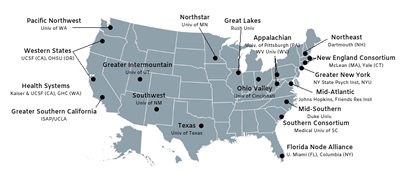 Congratulations and welcome to five new Nodes added to the CTN!
 The
The 
 Stimulant Webinar Series, Join the Northwest and Great Lakes ATTCs this summer for a 3-part webinar series on stimulant use disorder.


