Apply for the UCSF Learning for Early Careers in Addiction and Diversity (LEAD) Program |
SHARE ISSUE ON |

|
|

Application Deadline: December 30, 2020
The Learning for Early Careers in Addiction and Diversity (LEAD) Program at UCSF is looking to recruit its seventh cohort of visiting scholars to participate in this 3-year research education training program.
The LEAD Program uses the NIDA Clinical Trials Network (CTN) as a platform for training early-career investigators.
The application deadline is December 30, 2020. All qualified early-stage research scientists from underrepresented racial/ethnic backgrounds with a research focus in substance use are highly encouraged to apply. Referrals of specific candidates would be especially appreciated. We are happy to make the first contact and provide details directly to the candidate.
Download the flyer for more information.
· · · · · · · · · · · · · · · · · · · · · · · · · · · · · · · · ·
CTN Steering Committee Meeting: Save the Date!
Reminder that the next Annual Steering Committee Meeting will be held virtually from April 26-29, 2021.
Registration and agenda information coming soon! |
CTN Trial Progress
 Randomizations for Active Studies as of the November 11, 2020 trial Progress Report. Randomizations for Active Studies as of the November 11, 2020 trial Progress Report.
CTN-0060-A-1 - Validating Screening Tools for Teens. Enrolled 45
CTN-0069 - OUD in the Emergency Department. Enrolled 757
Total randomizations in active trials: 802
|
· · · · · · · · · · · · · · · · · · · · · · · · · · · · · · · · · · · · · · · ·
· · · · · · · · · · · · · · · · · · · · · · ·
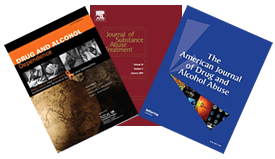 New in the CTN Dissemination Library New in the CTN Dissemination Library
Tobacco Cessation Services in Addiction Treatment: What Do Clients Say? Guydish JR, Yip D, Le T, Gubner NR, Williams DD, Delucchi KL. Psychiatric Services 2019;70:229-232
Opioid Use Disorder in Women and the Implications for Treatment. Barbosa-Leiker C, Campbell ANC, McHugh RK, Guille C, Greenfield SF. Psychiatric Research and Clinical Practice 2020 (in press).
Integrating Telemedicine for Medication Treatment for Opioid Use Disorder in Rural Primary Care: Beyond the COVID Pandemic [commentary]. Hser Y, Mooney LJ. Journal of Rural Health 2020 (in press).
Are Non-Abstinent Reductions in World Health Organization Drinking Risk Level a Valid Treatment Target for Alcohol Use Disorders in Adolescents with ADHD? Mitchell HM, Park G, Hammond CJ. Addictive Behaviors Reports 2020 (in press).
· · · · · · · · · · · · · · · · · · · · · · · · · · · · · · · · · · · · · · · ·
· · · · · · · · · · · · · · · · · · · · · · ·
News from the Nodes
Western States and Big Southwest Nodes
The Western States Node and Big South/West Nodes cosponsored a presentation on the increase of fentanyl on the West Coast. Fentanyl deaths increased 10-fold from 2013 to 2018, but the Western US was insulated from the drug which was concentrated in the Midwest, Appalachia, and New England. This presentation by Chelsea Shover of Stanford University of the Western States Node, presents evidence that fentanyl is unfortunately spreading west. She and her team systematically searched jurisdictions west of the Mississippi River for publicly available data on fentanyl-related deaths from 2019 and 2020. This allowed identification of fentanyl-related mortality rate and proportion of fatal heroin, stimulant, and prescription pill overdoses involving fentanyl to a much more recent date than CDC has yet reported.
Seven jurisdictions had publicly available fentanyl death data through December 2019 or later. All reported increased fentanyl deaths over the study period. Their collective contribution to national synthetic narcotics mortality increased 371% from 2017 to 2019. Available 2020 data shows a 63% growth in fentanyl-mortality over 2019. Fentanyl-involvement in heroin, stimulant, and prescription pill deaths has substantially grown. After Dr. Shover’s presentation we discussed how we can respond as clinicians, researchers, and policymakers.
For information about the presentation, please contact Jesse Guyer (guyerj@ohsu.edu). |
Protocol Update
CTN-0100 (RDD)
 In CTN-0100 (RDD) news: Wave 1 National training for RDD is taking place this week! Wave 1 sites, including Adapt (Oregon), Bellevue (New York), Chestnut Ridge Center (West Virginia), Gateway (Florida), Gibson Recovery Center (Missouri), Liberation Programs (Connecticut), Mountain Manor (Maryland), Square Medical Group (Massachusetts), SSTAR (Massachusetts), and UNI at the University of Utah, are all participating in a virtual Investigator’s meeting. Recruitment is expected to start in early 2021. Wave 2 sites will begin site readiness activities in March 2021. In CTN-0100 (RDD) news: Wave 1 National training for RDD is taking place this week! Wave 1 sites, including Adapt (Oregon), Bellevue (New York), Chestnut Ridge Center (West Virginia), Gateway (Florida), Gibson Recovery Center (Missouri), Liberation Programs (Connecticut), Mountain Manor (Maryland), Square Medical Group (Massachusetts), SSTAR (Massachusetts), and UNI at the University of Utah, are all participating in a virtual Investigator’s meeting. Recruitment is expected to start in early 2021. Wave 2 sites will begin site readiness activities in March 2021.
In other study milestones: National Site Calls began in September, and Protocol v2.0 was approved by the sIRB (BRANY) in October.
For study information, please contact RDD at rdd@nyulangone.org.
· · · · · · · · · · · · · · · · · · · · · · · · · · · · · · · · · · · · ·
New CTN Protocols!
Several new protocols have been added to the CTN Dissemination Library's Protocols section, as well as to NIDA's website for the CTN. Check them out to see what's coming up for RRTC's and CTPs in the network! |
|
· · · · · · · · · · · · · · · · · · · · · · · · · · · · · · · · · · · · · · · ·
· · · · · · · · · · · · · · · · · · · · · · ·
 CTN Webinar: Tailoring Informed Consent for Substance Use Disorders. CTN Webinar: Tailoring Informed Consent for Substance Use Disorders.
Did you miss last month's CTN webinar on tailoring informed consent? You can now watch the recording on the CTN Dissemination Library website!
In this session, representatives from the Office for Human Research Protections (OHRP) discussed relevant Common Rule requirements and what goes into a meaningful informed consent for research involving participants with substance use disorders.
Learning Objectives:
- Explain why getting meaningful consent is critical to enrolling research participants.
- Describe relevant Common Rule requirements for substance abuse research.
- Describe some of the important components for a meaningful consent.
Download slides | View recording
· · · · · · · · · · · · · · · · · · · · · · · · · · · · · · · · · · · · · · · · · · · · · · · · · · · · · · · · · · · · · · ·
   
|