Search the Library
NOTE: This is a new search platform (as of May 2026). If you do a search and don’t get the results you were expecting, please email us at ctnlib@uw.edu to let us know? (If possible, please share your exact search strategy. Thank you!)
Enter keywords and hit Enter (or click the magnifying glass) to search. You can then also select document type or subject/topic to narrow results further (or just use those for searching without a keyword). Results display below this search form.
Document types
Subjects
- CTN-#### format for protocols (CTN-0001, e.g.)
- “exact phrase” (if phrase is not found, it will return results that contain all terms
- word1 NOT word2
- word1 word2 (finds both words)
- Click title to access full-text
- “Show details” reveals abstract & other info
- Checkboxes select items for copy/pasting or printing
- Need help getting a copy of a journal article?
Email ctnlib@uw.edu
Search results
 This is the Results Article for CTN-0014-A-1.
Isomorphism, or parallel process, occurs in family therapy when patterns of therapist-client interaction replicate problematic interaction patterns within the family. This study investigated parallel demand-withdraw process in Brief Strategic Family Therapy (BSFT) for adolescent drug abuse, hypothesizing that therapist-demand/adolescent-withdraw interaction (TD/AW) cycles observed early in treatment would predict poor adolescent outcomes at follow-up for families who exhibited entrenched parent-demand/adolescent-withdraw interaction (PD/AW) before treatment began.
Participants were 91 families who received at least four sessions of BSFT in the National Drug Abuse Treatment Clinical Trials Network (CTN) study CTN-0014 (“Brief Strategic Family Therapy (BSFT) for Adolescent Drug Abusers”), a multisite clinical trial on adolescent drug abuse. Prior to receiving therapy, families completed videotaped family interaction tasks from which trained observers coded PD/AW. Another team of raters coded TD/AW during two early BSFT sessions. The main dependent variable was the number of drug-use days that adolescents reported in timeline follow-back interviews 7 to 12 months after family therapy began. Zero-inflated Poisson regression analyses supported the main hypothesis, showing that PD/AW and TD/AW interacted to predict adolescent drug use at follow-up. For adolescents in high PD/AW families, higher levels of TD/AW predicted significant increases in drug use at follow-up, whereas for low PD/AW families, TD/AW and follow-up drug use were unrelated.
Conclusions: Results suggest that attending to parallel demand–withdraw processes in parent–adolescent and therapist–adolescent dyads may be useful in family therapy for substance-using adolescents, as it appears that parallel demand-withdraw processes in family therapy for adolescent drug abuse can compromise treatment outcome. Findings highlight two key BSFT principles — remaining decentralized and placing more demand for change on parents than on adolescents — and suggest these principles are particularly important to observe with therapists work with families that exhibit PD/AW.
Related protocols: CTN-0014-A-1
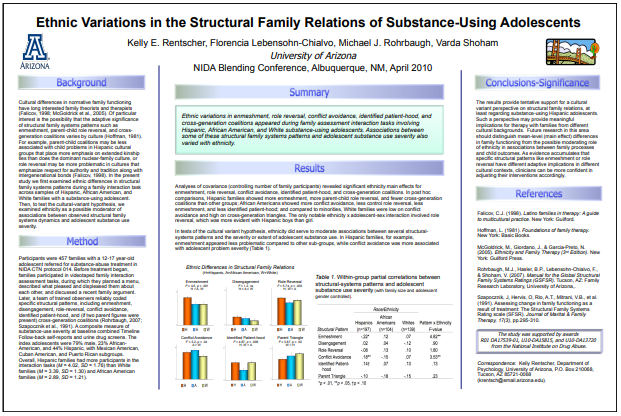
Cultural differences in normative family functioning have long interested family theorists and therapists. Of particular interest is the possibility that the adaptive significance of structural family systems patterns such as enmeshment, parent-child role reversal, and cross-generation coalitions varies by culture. For example, parent-child coalitions may be less associated with child problems in Hispanic cultural groups that place more emphasis on extended kinship ties than does the dominant nuclear-family culture, or role reversal may be more problematic in cultures that emphasize respect for authority and tradition along with intergenerational bonds. The present study examined data from CTN-0014 (“Brief Strategic Family Therapy for Adolescent Drug Abusers”) to look at ethnic differences in structural family systems patterns during a family interaction task across samples of Hispanic, African American, and White families with a substance-using adolescent. Then, the cultural-variant hypothesis was testing through an examination of ethnicity as a possible moderator of associations between observed structural family systems dynamics and adolescent substance use severity. Results provide tentative support for a cultural variant perspective on structural family relations, at least regarding substance-using Hispanic adolescents. Such a perspective may provide meaningful implications for therapy with families from different cultural backgrounds.
Related protocols: CTN-0014-A-1
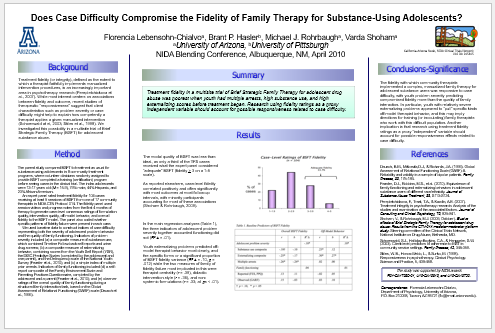 Treatment fidelity (or integrity), defined as the extent to which a therapist faithfully implements manualized intervention procedures, is an increasingly important area in psychotherapy research. While most interest centers on associations between fidelity and outcome, recent studies of therapeutic “responsiveness” suggest that client characteristics such as problem severity or case difficulty might help to explain how competently a therapist applies a given manualized intervention. This poster reports on a study investigating this possibility in the Brief Strategic Family Therapy (BSFT) protocol, CTN-0014.
Results found that the fidelity with which community therapists implemented BSFT was responsive to case difficulty, with youth problem severity predicting compromised fidelity more than the quality of family interaction. In particular, youth with relatively severe externalizing problems appeared to pull specific kinds of off-model therapist behavior, and this may imply directions for training (or inoculating) family therapists who work with this difficult population. Another implication is that research using treatment fidelity ratings as a proxy independent variable should account for possible responsiveness effects related to case difficulty.
Related protocols: CTN-0014-A-1
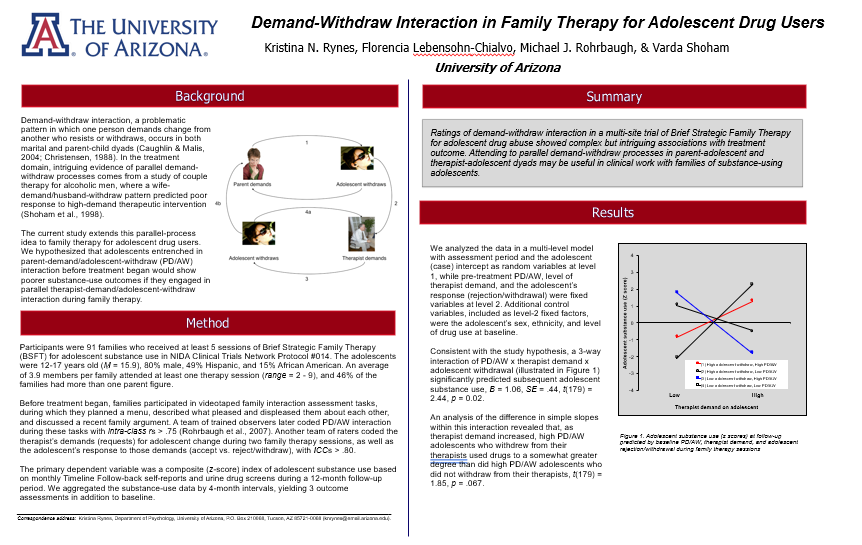 Demand-withdraw interaction, a problematic pattern in which one person demands a change from another who resists or withdraws, occurs in both marital and parent-child dyads. In the treatment domain, intriguing evidence of a parallel demand-withdraw process comes from a study of couple therapy for alcohol men, where a wife-demand/husband-withdraw pattern predicted poor response to a high-demand therapeutic intervention. This study, an ancillary investigation of data from protocol CTN-0014, “Brief Strategic Family Therapy (BSFT) for Adolescent Drug Abusers,” extends this parallel-process idea to family therapy for adolescent drug users. Researchers hypothesized that adolescents entrenched in parent-demand/adolescent-withdraw (PD/AW) interaction before treatment began would show poorer substance use outcomes if they engaged in parallel therapist-demand/adolescent-withdraw interaction during family therapy. Results suggest that attending to these parallel demand-withdraw processes (parent/adolescent and therapist/adolescent) may be useful in clinical work with families of substance-using adolescents. In particular, an inadvertent replication of ineffective parent behavior within the therapeutic system may undermine the prospect of positive youth outcomes. Case conceptualization and treatment planning for families exhibiting high levels of PD/AW interaction may benefit from consideration of how the therapist can best maintain balanced alliances and avoid a high-demand stance toward the target adolescent.
Related protocols: CTN-0014-A-1
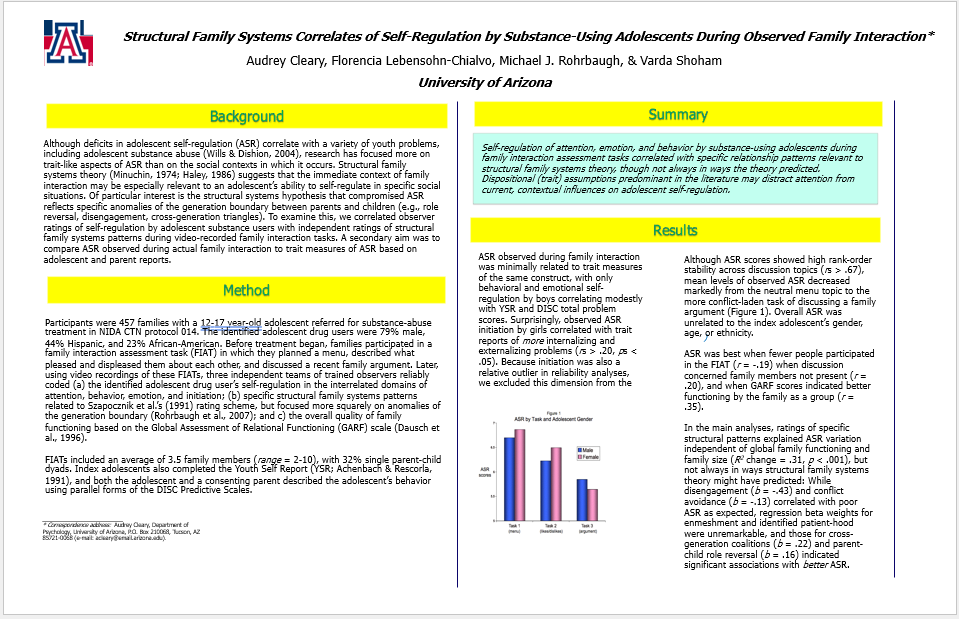 Although deficits in adolescent self-regulation (ASR) correlate with a variety of youth problems, including adolescent substance abuse, research has focused more on trait-like aspects of ASR than on the social contexts in which it occurs. Structural family systems theory suggests that the immediate context of family interaction may be especially relevant to an adolescent’s ability to self-regulate in specific social situations. Of particular interest is the structural systems hypothesis that compromised ASR reflects specific anomalies of the generation boundary between parents and children (e.g., role reversal, disengagement, cross-generation triangles). Using data from protocol CTN-0014, “Brief Strategic Family Therapy (BSFT) for Adolescent Drug Abusers,” the researchers aimed to correlate observer ratings of self-regulation by adolescent substance users with independent ratings of structural family systems patterns during video-recorded family interaction tasks. A secondary aim was to compare ASR observed during actual family interaction to trait measures of ASR based on adolescent and parent reports.
Results showed that adolescents regulate themselves best when their family functions well as a group. Self-regulation of attention, emotion, and behavior by substance-using adolescents during family interaction assessment tasks correlated with specific relationship patterns relevant to structural family systems theory, though not always in ways the theory predicted. Dispositional (trait) assumptions predominant in the literature may distract attention from current, contextual influences on adolescent self-regulation.
Related protocols: CTN-0014-A-1
 This presentation begins with an update on the CTN-0014 platform study, “Mediators and Moderators of BSFT for Adolescent Drug Use.” Previous research on BSFT, a family therapy based on structural family systems theory, has focused mainly on outcomes, with little attention to how the treatment actually works or for whom it might be the most beneficial. Using protocol CTN-0014 as a platform, the authors tested hypotheses about mediators and moderators of BSFT. The study found within-treatment associations between BSFT fidelity and outcome, with minority participants accounting for most of these associations. Associations between BSFT fidelity and observed family change also varied by ethnicity, with significant correlations appearing for minority families, but not whites. Unfortunately, the study also found that the modal quality of BSFT was considerably less than ideal — most of the cases reviewed by the investigators featured BSFT that was considered less than adequate. As fidelity is at the heart of good psychosocial intervention trials, good treatment effectiveness research, and replicable dissemination, the fact that establishing and maintaining high fidelity was very difficult in this trial warrants further examination.
The presentation ends with reflections on future directions for the CTN, including ways to elevate the study of mechanisms, focus on moderators at both the case and organizational level, study therapist development to maximize fidelity, and have centrally organized but independently conducted trials across sites.
Related protocols: CTN-0014, CTN-0014-A-1