Search the Library
NOTE: This is a new search platform (as of May 2026). If you do a search and don’t get the results you were expecting, please email us at ctnlib@uw.edu to let us know? (If possible, please share your exact search strategy. Thank you!)
Enter keywords and hit Enter (or click the magnifying glass) to search. You can then also select document type or subject/topic to narrow results further (or just use those for searching without a keyword). Results display below this search form.
Document types
Subjects
- CTN-#### format for protocols (CTN-0001, e.g.)
- “exact phrase” (if phrase is not found, it will return results that contain all terms
- word1 NOT word2
- word1 word2 (finds both words)
- Click title to access full-text
- “Show details” reveals abstract & other info
- Checkboxes select items for copy/pasting or printing
- Need help getting a copy of a journal article?
Email ctnlib@uw.edu
Search results
 Pregnant individuals with substance use disorders face complex issues that may serve as barriers to treatment entry and retention. Several professional organizations have established recommendations on comprehensive, collaborative approaches to treatment to meet the needs of this population, but information on real-world application is lacking. Sites participating in the NIDA CTN-0080 “Medication treatment for Opioid use disorder in expectant Mothers (MOMs)”–a randomized clinical trial of extended release compared to sublingual buprenorphine among pregnant and postpartum individuals (PPI)–were selected, in part, because they have a collaborative approach to treating PPI with opioid use disorder (OUD). However, organizational differences among sites and how they implement expert recommendations for collaborative care could impact study outcomes.
Prior to study launch at each of the 13 MOMs sites, investigators used the Pregnancy and Addiction Services Assessment (PAASA) to collect information about organizational factors. Input from a team of addiction, perinatal, and economic evaluation experts guided the development of the PAASA. Investigators programmed the PAASA into a web-based data system and summarized the resultant site data using descriptive statistics.
Study sites represented four US census regions. Most sites were specialty obstetrics & gynecology (OB/GYN) programs providing OUD services (n = 9, 69.2 %), were affiliated with an academic institution (n = 11, 84.6 %), and prescribed buprenorphine in an ambulatory/outpatient setting (n = 11, 84.6 %); all sites offered access to naloxone. Sites reported that their population was primarily White, utilized public insurance, and faced numerous psychosocial barriers to treatment. Although all sites offered many services recommended by expert consensus groups, they varied in how they coordinated these services.
Conclusions: By providing the organizational characteristics of sites participating in the MOMs study, this report assists in filling the current gap in knowledge regarding similar programs providing services to PPI with OUD. Collaborative care programs such as those participating in MOMs are uniquely positioned to participate in research to determine the most effective models of care and to determine how research can be integrated into those clinical care settings.
Related protocols: CTN-0080
This 90-minute presentation addressed success factors in site management and performance as site staff prepare for initiation and implementation of multi-site clinical trials. It also included discussion on the various indicators for performance success.
Objectives include:
- Review strategies for improving site management and performance success;
- Understand the management of sites in the pre-implementation, implementation, and closeout phases of multi-site clinical trials;
- Consider factors that contribute to the successful performance of a trial.
The target audience includes research/clinical counselors and staff both in the CTN and in the general public.
Presented by Allan J. Cohen, MA, MFT (Bay Area Addiction Research & Treatment, PR Node), Dorothy Sandstrom, MS (Western Psychiatric Institute and Clinic, ATS Node) and Gregory S. Brigham, PhD (Maryhaven, Inc., OV Node).
Additional Resources:
- Download slides (pdf)
This 1-hour webinar will acquaint research staff with site closeout activities and the various aspects to consider for regulatory, safety, personnel, records management, and internal and external resources. The course will include:
Explanation of all aspects of closing out sites.
Description of a smooth closeout process.
Closeout preparation related activities that should occur even before site endorsement.
The target audience includes research/clinical counselors and staff both in the CTN and in the general public.
Presented by Maria Campanella, BSN, RN, CCRA, EMMES Corporation.
Additional Resources:
- Download slides (pdf)
 Although the selection of appropriate clinical sites has a significant impact on the successful conduct of clinical trials, no generally accepted model is available for site selection. Use of an appropriate site selection process is even more pertinent when conducting large scale, practical clinical trials in practice settings. This report provides a rationale for selecting sites by identifying both a set of basic site selection criteria important to most trials as well as criteria specific to the features of a particular study’s design. In this two-tier system, although all these criteria must be met, some criteria are firm and viewed as essential for a site to conduct the trial. Other criteria, such as those that support study recruitment or participant retention, are flexible. These flexible criteria may be addressed through several alternative solutions that meet the original intent of the criterion.
This report illustrates how the study specific features and requirements of the Stimulant Reduction Intervention Using Dosed Exercise (STRIDE) protocol (CTN-0037), a multisite clinical trial in the National Drug Abuse Treatment Clinical Trials Network evaluating the efficacy of exercise or health education for stimulant abuse treatment, are linked to firm and flexible site selection criteria. The authors also present an iterative, multi-step approach to site selection including building awareness about the study and screening and evaluating sites using these criteria.
Conclusions: This simple model could maximize the chance that selected sites will implement a study successfully and achieve trial aims. It may be helpful to researchers who are developing criteria and methods for site selection for specific clinical trials. The success of these selection criteria and comprehensive approach to site selection has yet to be determined. However, to fill the gap in the literature about the science of site selection, models and tools based on this and other trialists’ experiences are needed. It would be useful to see reports on this issue from other researchers.
Related protocols: CTN-0037
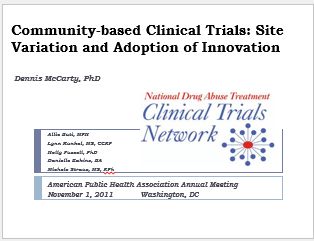 The National Drug Abuse Treatment Clinical Trials Network (CTN) conducts multi-site clinical trials in community-based drug abuse treatment centers to test the effectiveness and generalizability of emerging pharmacological and behavioral therapies for drug addiction. Site differences are common in multi-site trials but the sources of the variation are unclear. A trial of interventions to reduce HIV risk behaviors, for example, found that a site characteristic (distance between a detoxification center and an outpatient center) was the strongest predictor of entering outpatient care following detoxification. To begin to address site variation, the CTN collects workforce and organizational data at participating sites prior to implementing new trials. Data from four trials suggest that sites varied prior to trial implementation on staff composition (e.g., % counselors with graduate degrees, % counselors in recovery), and clinical director commitment to implementation. Sites also vary on how the protocol is organized and implemented within each treatment center. Clinical directors were more committed to protocol implementation than counselors. Counselors were more committed to implementation of a twelve-step facilitation protocol than to a smoking cessation protocol. Variation was apparent both within and across trials. The variation may affect protocol implementation and influence client outcomes. Future analyses will link site data with patient outcomes. It is essential to begin to understand the sources of site variation in outcomes.