Structural family systems correlates of self-regulation by substance-using adolescents during observed family interaction.
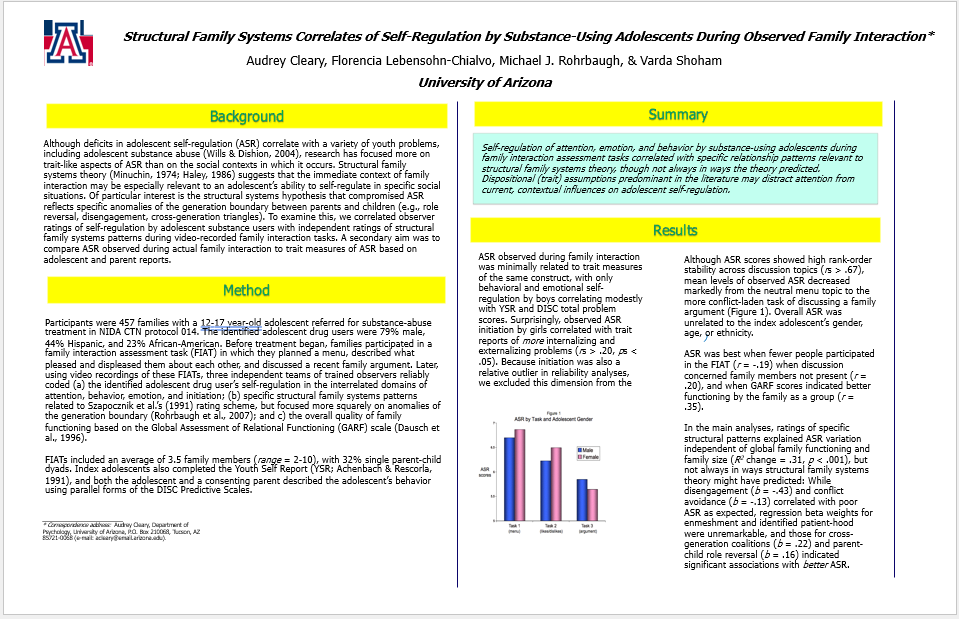 Although deficits in adolescent self-regulation (ASR) correlate with a variety of youth problems, including adolescent substance abuse, research has focused more on trait-like aspects of ASR than on the social contexts in which it occurs. Structural family systems theory suggests that the immediate context of family interaction may be especially relevant to an adolescent’s ability to self-regulate in specific social situations. Of particular interest is the structural systems hypothesis that compromised ASR reflects specific anomalies of the generation boundary between parents and children (e.g., role reversal, disengagement, cross-generation triangles). Using data from protocol CTN-0014, “Brief Strategic Family Therapy (BSFT) for Adolescent Drug Abusers,” the researchers aimed to correlate observer ratings of self-regulation by adolescent substance users with independent ratings of structural family systems patterns during video-recorded family interaction tasks. A secondary aim was to compare ASR observed during actual family interaction to trait measures of ASR based on adolescent and parent reports.
Results showed that adolescents regulate themselves best when their family functions well as a group. Self-regulation of attention, emotion, and behavior by substance-using adolescents during family interaction assessment tasks correlated with specific relationship patterns relevant to structural family systems theory, though not always in ways the theory predicted. Dispositional (trait) assumptions predominant in the literature may distract attention from current, contextual influences on adolescent self-regulation.
Related protocols: CTN-0014-A-1