Does case difficulty compromise the fidelity of family therapy for substance-using adolescents?
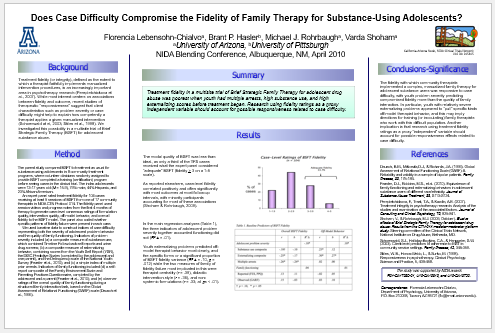 Treatment fidelity (or integrity), defined as the extent to which a therapist faithfully implements manualized intervention procedures, is an increasingly important area in psychotherapy research. While most interest centers on associations between fidelity and outcome, recent studies of therapeutic “responsiveness” suggest that client characteristics such as problem severity or case difficulty might help to explain how competently a therapist applies a given manualized intervention. This poster reports on a study investigating this possibility in the Brief Strategic Family Therapy (BSFT) protocol, CTN-0014.
Results found that the fidelity with which community therapists implemented BSFT was responsive to case difficulty, with youth problem severity predicting compromised fidelity more than the quality of family interaction. In particular, youth with relatively severe externalizing problems appeared to pull specific kinds of off-model therapist behavior, and this may imply directions for training (or inoculating) family therapists who work with this difficult population. Another implication is that research using treatment fidelity ratings as a proxy independent variable should account for possible responsiveness effects related to case difficulty.
Related protocols: CTN-0014-A-1