Modifying practices in a MAT program to the needs of the local patient population.
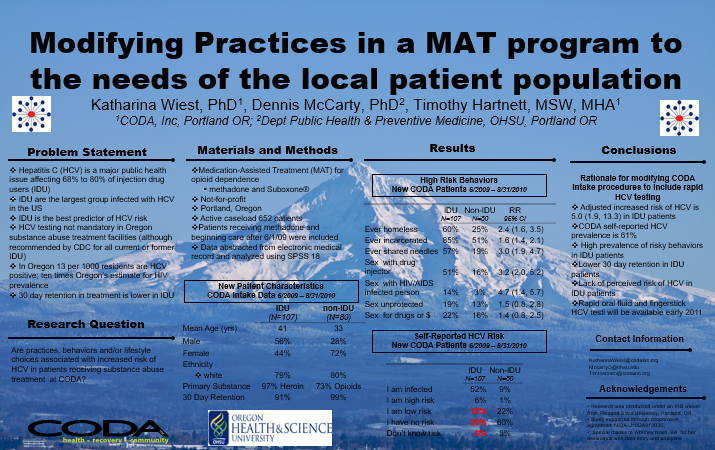 As a member of the Oregon/Hawaii Node, the community treatment program (CTP) CODA, Inc. frequently participates in NIDA’s CTN clinical trials, including the recently completed rapid HIV testing trial (CTN-0032). Incorporating research lessons learned from the CTN experience into their treatment practice, CODA, a medication-assisted treatment (MAT) program for opioid dependence, expanded its electronic medical record data to include high risk behaviors, infectious diseases and greater attention to non-prescription use of opioid analgesics. The goal is to more appropriately tailor the substance abuse treatment to the identified needs of the local patient population. The self-reported prevalence of Hepatitis C (HCV) in new MAT patients is 35% and 49% in heroin dependent individuals. Despite being the group at highest risk for HCV, needle using heroin patients, when asked to assess their HCV risk, 58% reported being at low to no risk. The heroin dependent patients were also the individuals most likely to report engaging in high-risk behaviors such as “sex for drugs” or needle sharing. These findings illustrate the need for onsite rapid HCV testing and use of intensive HCV prevention curriculum. Non-prescription use of opioid analgesics rose to 33% of all new CODA patients seeking treatment and constitutes the drug of choice for 46% of women beginning MAT. All MAT withdrawals occurring before 90 days of treatment were in the heroin dependent patients. Clinical implications for ways to increase patient retention based on drug of choice and reduction in behaviors associated with compromised outcomes will be discussed.
Related protocols: CTN-0032