A comparative example of missing data strategies in substance abuse clinical trials using generalized estimating equations (GEE).
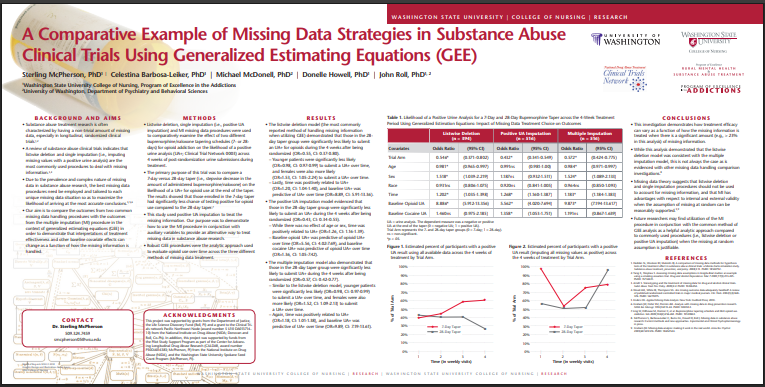 Substance abuse treatment research is often characterized by having a non-trivial amount of missing data, especially in longitudinal, randomized clinical trials. A review of substance abuse clinical trials indicates that listwise deletion and single imputation (i.e., imputing missing values with a positive urine analysis) are the most commonly used procedures to deal with missing information. Due to the prevalence and complex nature of missing data in substance abuse research, the best missing data procedures need to be employed and tailored to each unique missing data situation so as to maximize the likelihood of arriving at the most accurate conclusions. This poster reports on a study that compared the outcomes from two common missing data handling procedures, using data sets from protocol CTN-0003, with the outcomes from the multiple imputation (MI) procedure in the context of generalized estimating equations (GEE) in order to demonstrate that interpretations of treatment effectiveness and other baseline covariate effects can change as a function of how the missing information is handled.
Conclusions: The investigation demonstrated how treatment efficacy can vary as a function of how the missing information is treated when there is a significant amount of it. Missing data theory suggests that listwise deletion and single imputation procedures should not be used to account for missing information, and that MI has advantages with respect to internal and external validity when the assumption of missing at random can be reasonably supported. Future researchers may find utilization of the MI procedure in conjunction with the common method of GEE analysis as a helpful analytic approach compared to commonly used procedures when the missing at random assumption is justifiable.
Related protocols: CTN-0003