Body mass index (BMI) and obesity prevalence among substance abuse participants from NIDA’s Clinical Trials Network (CTN).
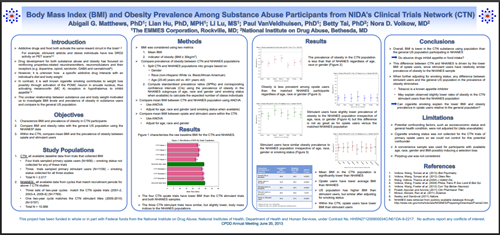 Though behavioral and pathological similarities between binge eating disorder and substance use disorders are known to researchers, associations between them are poorly studied. We compared pre-treatment BMI in substance users from 7 National Drug Abuse Treatment Clinical Trials Network (CTN) clinical trials with BMIs for age, race and gender comparable participants from the National Health and Nutrition Examination Survey (NHANES). Standardized Prevalence Ratio (SPR) of obesity (BMI>=30kg/m2) was estimated and adjusted for age, gender, and race. ANOVA test was used to compare adjusted mean BMI. Cigarette smoking status was also adjusted for in a subset of participants with available data. Results: CTN participants had lower BMI (N=2017, mean=26.6kg/m2) than NHANES participants (N=10966, mean=28.6kg/m2, p<0.0001). Crude obesity prevalence was 23% and 37% in CTN and NHANES participants, respectively. Adjusted obesity prevalence in CTN participants was 32% lower than NHANES (SPR=0.68, 95% CI: 0.62-0.74). Obesity prevalence in NHANES participants was 2.75 times that in CTN opiate users (N=908, SPR=2.75, 95% CI: 2.27-3.38), but only 1.21 times that in CTN stimulant users (N=1109, SPR=1.21, 95% CI: 1.09-1.34). After further adjusting for smoking, obesity prevalence in CTN stimulant users was not different from NHANES participants (SPR=0.99, 95% CI: 0.90-1.10). BMI for CTN opiate users (mean=25.1kg/m2) was lower than for stimulant users (mean=28.2kg/m2, p<0.001), while obesity prevalence in stimulant users was 2.54 times that in opiate users (SPR=2.54, 95% CI: 2.29-2.81).
Conclusions: Obesity prevalence was significantly lower in substance abusers from CTN trials than in a matched sample of general population. The difference was driven by significantly lower BMI and obesity prevalence in opiate than stimulant users, suggesting substance-specific effects on energy homeostasis and weight regulation. These results warrant further research on relationships between substance use, diet and weight.