Growth mixture modeling of stimulant use treatment effects and differential trajectories: Evidence from two contingency management clinical trials.
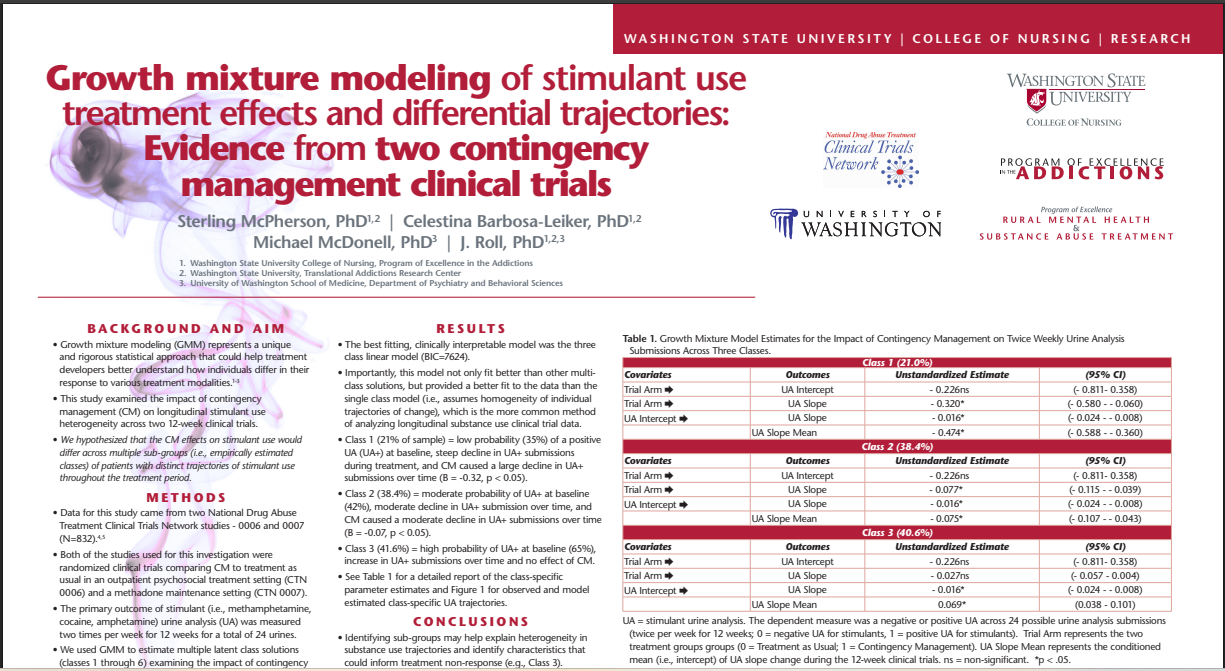 This study examined the impact of contingency management (CM) on stimulant use heterogeneity across two 12-week clinical trials, National Drug Abuse Treatment Clinical Trials Network protocols CTN-0006 and CTN-0007. The hypothesis was that CM effects on stimulant use would differ across multiple sub-groups of patients with distinct trajectories of use throughout the treatment period. The outcome of positive stimulant urine analysis (UA+) was measured two times per week for 12 weeks. Growth mixture modeling was used to estimate multiple latent class solutions (classes 1 through 6). The best fitting, clinically interpretable model was the 3-class linear model (BIC=7624). The model produced the following classes: Class 1 (21% of sample) = low probability (35%) of UA+ at baseline, steep decline in UA+ submissions during treatment. Class 2 (38%) = moderate probability of UA+ at baseline (42%), moderate decline in UA+ submissions over time caused by CM. Class 3 (41%) = high probability of UA+ at baseline (65%), increase in UA+ submissions over time and no effect of CM.
Conclusions: Identifying sub-groups may help explain heterogeneity in substance use trajectories and identify characteristics that could inform treatment nonresponse (e.g. Class 3). Such models could also assist with identifying segments of the stimulant use population who could benefit from ancillary services in order to more effectively impact abstinence.
Related protocols: CTN-0006, CTN-0007