Treatment satisfaction in the CTN Cocaine Use Reduction with Buprenorphine (CURB) study.
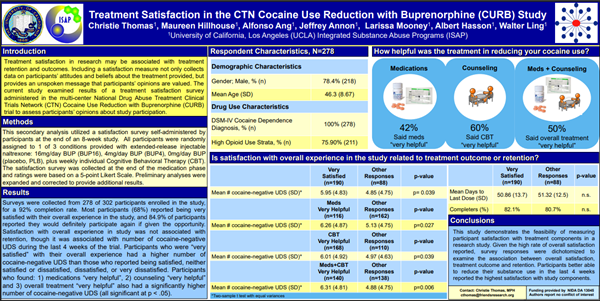 Treatment satisfaction in research may be associated with treatment retention, engagement, and outcomes. Including a satisfaction measure not only collects data on participants’ attitudes about the treatment provided, but provides an unspoken message that participants’ opinions are valued. The current study examines results of a treatment satisfaction survey administered to participants enrolled in the multi-center National Drug Abuse Treatment Clinical Trials Network (CTN) Cocaine Use Reduction with Buprenorphine (CURB, CTN-0048) trial to assess opinions about study participation. This secondary analysis uses a 9-item satisfaction survey self-administered by cocaine-dependent participants at the end of the 8-week study. All participants received extended-release injectable naltrexone and were randomly assigned to 1 of 3 daily, sublingual buprenorphine/naloxone (BUP) conditions: 16mg BUP (BUP16), 4mg BUP (BUP4), 0mg BUP (placebo, PLB), plus weekly CBT. Satisfaction ratings were based on a 5-point Likert Scale.
Two hundred and seventy-eight (278) surveys were collected for a 92% completion rate. Most participants (93.5%) reported being satisfied or very satisfied with their overall experience in the study, and 84.9% reported that they would definitely participate again if given the opportunity. No difference in overall satisfaction was found between the BUP groups and the PLB group (BUP4 vs PLB, p=0.08; BUP16 vs PLB, p=0.43). Satisfaction was not associated with retention, CBT attendance, or cocaine use outcomes. Participants were also asked to what medication group they thought they were assigned, and 56.8% had an opinion whereas 43.2% were unsure. Of those with an opinion, 26.3% correctly guessed their group assignment. Additional analyses of items addressing participant opinion of the study medication and counseling will be presented.
Conclusions: Given the high rates of treatment satisfaction reported by study participants, it is not surprising that satisfaction is not related to treatment performance and outcome. Interestingly, participant guesses about assigned treatment were no better than chance. This seems to demonstrate the effectiveness of the study blinding process.