Treatment expectations and associated outcomes in motivational enhancement therapy delivered in English and Spanish.
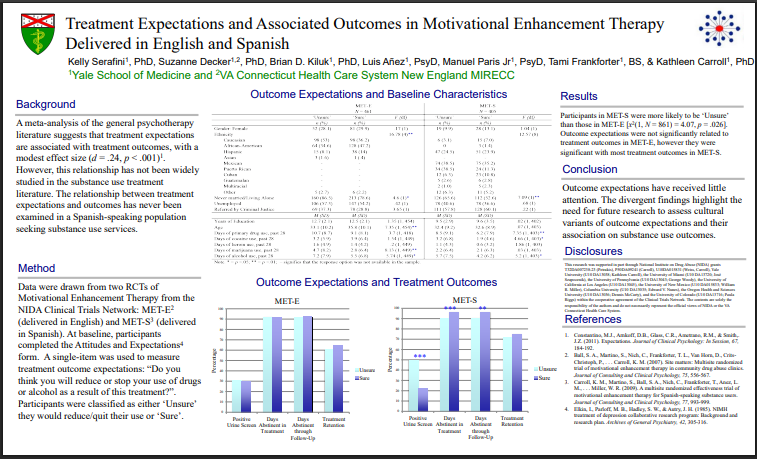 In order to determine if expectations at pre-treatment are associated with substance use treatment outcomes, this study examined treatment expectations in two National Drug Abuse Treatment Clinical Trials Network (CTN) randomized controlled trials (RCTs) utilizing Motivational Enhancement Therapy (MET) for the treatment of substance use (CTN-0004 and CTN-0021). One RCT was delivered in English (MET-E) and one was delivered in Spanish (MET-S). There were 461 participants MET-E sample and 405 participants MET-S. Participants responded to the following item at pre-treatment: “Do you think you will reduce or stop your use of drugs or alcohol as a result of this treatment?” ANOVAs and chisquare tests were used to examine the relationship between treatment expectations and treatment outcomes in the two samples.
Treatment expectations were not associated with any of the treatment outcomes in MET-E. However, in MET-S, expectations were significantly associated with most of the post-treatment outcomes. Among these, treatment expectations were significantly associated with the percentage of drug positive urines within the treatment period, F (1, 1,163) = 18.83, p = .000, and the percentage of days abstinent from primary drug use while in treatment and through follow-up, F (1, 1,364) = 23.78, p = .000.
Conclusions: There are several possible interpretations to the divergent findings between samples. The first is that the MET-S sample had fewer previous treatments, and that when a treatment is novel, expectations may have more of an influence. The second interpretation is that there may be cultural components that may affect how an individual relates to the treatment process. These findings are preliminary and future research should examine treatment expectations across cultures.
Related protocols: CTN-0004, CTN-0021