Participants’ preferences for BUP-NX or XR-NTX and associations with induction success and relapse rates in the NIDA-CTN-0051, Extended-release naltrexone vs. buprenorphine for opioid treatment (X:BOT).
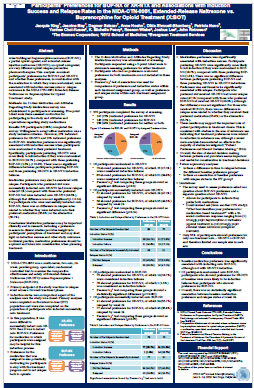 Sublingual buprenorphine-naloxone (BUP-NX), a partial opioid agonist, and extended-release injection naltrexone (XR-NTX), an opioid antagonist, are very different opioid relapse-prevention pharmacotherapies. This analysis examined participants’ preferences for BUP-NX and XR-NTX and whether these preferences, in combination with the medication to which they were randomized, were associated with induction success rates or relapse outcomes in the CTN-0051 Extended-Release Naltrexone vs. Buprenorphine for Opioid Treatment study.
An 11-item Motivation and Attitudes Regarding Study Medications survey was administered to participants at screening. Five-point Likert scale items assessed motivation for participating in the study and attitudes and expectations regarding study medications. 570 participants (100%) completed the survey. Willingness to accept either medication was a study inclusion criterion. However, 29% indicated preference for XR-NTX and 33% indicated preference for BUP-NX. Medication preference was significantly associated with induction success when participants were randomized to their preferred treatment. Specifically, participants preferring XR-NTX were more likely to fail induction if they were randomized to BUP-NX (18.7%), compared with those preferring BUP-NX (1.3%), p < 0 .0001. There was no significant difference between participants preferring BUP-NX and those preferring XR-NTX in XR-NTX induction failures. Medication preference may also be associated with relapse. Participants who preferred and received XR-NTX had lower relapse rates (47.1%) compared with those who preferred BUP-NX but received XR-NTX (60.3%), although that difference was not significant (p = 0.16). For participants who received BUP-NX, there was no difference in relapse rates related to whether they received their preferred medication (55.8%) or the alternative (55.7%).
Conclusions: Medication preference may be important clinically and in research. Including a preference measure in clinical studies provides insight into participants’ perceptions of treatment and may shed light on induction success and other study outcomes. In clinical practice, medication preferences should be explored and taken into consideration when planning treatment.
Related protocols: CTN-0051