Comparative effectiveness of extended-release naltrexone versus buprenorphine-naloxone for opioid relapse prevention (X:BOT): A multicenter, open-label, randomized controlled trial.
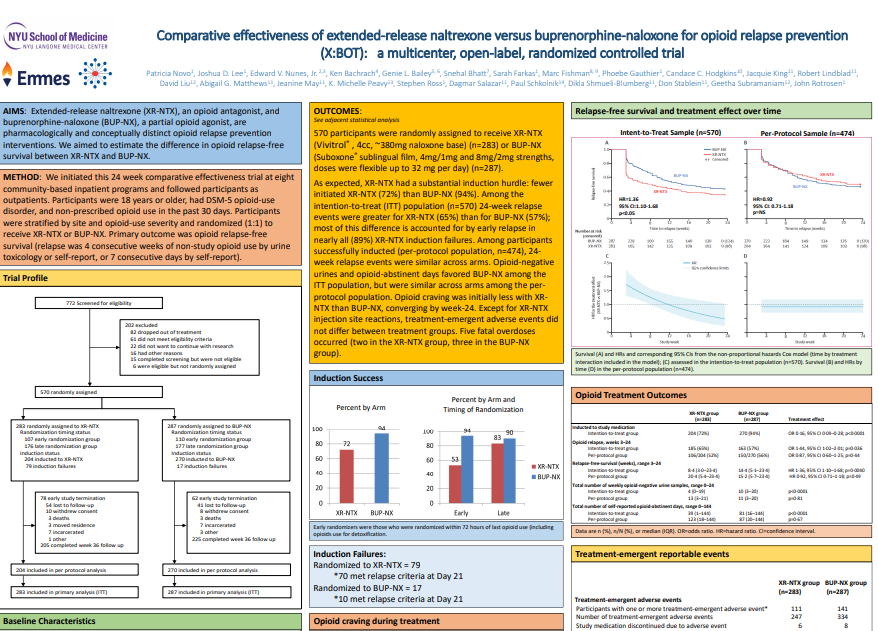 Extended-release naltrexone (XR-NTX), an opioid antagonist, and buprenorphine-naloxone (BUP-NX), a partial opioid agonist, are pharmacologically and conceptually distinct opioid relapse prevention interventions. This study aimed to estimate the difference in opioid relapse-free survival between XR-NTX and BUP-NX. This NIDA Clinical Trials Network protocol, CTN-0051, was initiated at 8 community-based inpatient programs, and followed participants as outpatients for 24 weeks. The primary outcome was opioid relapse-free survival (where relapse was defined as 4 consecutive weeks of non-study opioid use by urine toxicology or self-report, or 7 consecutive days by self-report).
Results found that, as expected, XR-NTX had a substantial induction hurdle — fewer initiated XR-NTX (72%) than BUP-NX (94%). Among the intention-to-treat (ITT) population (n=570), 24-week relapse events were greater for XR-NTX (65%) than for BUP-NX (57%). Most of this difference is accounted for by early relapse in nearly all (89%) XR-NTX induction failures. Among participants successfully inducted (n=474), 24-week relapse events were similar across arms. Opioid-negative urines and opioid-abstinent days favored BUP-NX among the ITT population, but were similar across arms among the per-protocol population. Opioid craving was initially less with XR-NTX than with BUP-NX, converging by week 24. Except for XR-NTX injection site reactions, treatment-emergent adverse events did not differ between treatment groups. Five fatal overdoses occurred (2 in the XR-NTX group, 3 in the BUP-NX group).
Conclusions: In these settings, it was more difficult for participants to initiate XR-NTX, and nearly all of those who failed induction quickly relapsed. Better overall opioid outcomes for the BUP-NX group in the intention-to-treat population were directly related to differential induction failure. No differences were found between the two groups for adverse events, serious adverse events, overdoses, and fatal overdoses. Future work should focus on facilitating induction to XR-NTX and on improving treatment retention on both medications.