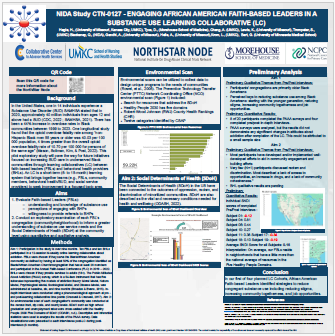
NIDA study CTN-0127: Engaging African American faith-based leaders in a substance use learning collaborative (LC).
 In the United States, one in 14 individuals experience a Substance Use Disorder (SUD). SAMHSA stated that in 2020, approximately 40 million individuals from ages 12 and above had a SUD (CDC, 2022 ; SAMHSA, 2021). There has been a 44% increase in overdose rates in Black communities between 1999 to 2023. One longitudinal study found that the opioid overdose fatality rate among “non-Hispanic Black men 55 years or older was 40.03 per 100,000 population, 4 times greater than the overall opioid overdose fatality rate of 10.70 per 100,000 for persons of the same age” (Mason, Soliman, Kim, & Post, 2022).
This poster describes CTN-0127, a pilot exploratory study that will pave the way for future initiatives focused on increasing SUD care in underserved Black communities through learning collaboratives (LC) between faith-based leaders (FBLs) and behavioral health providers (BHLs). An LC is a short-term (6- to 15-month) learning system that brings together teams (e.g., FBLs, community members, behavioral health/SUD, and social service providers) to seek improvement in a focused topic area.
Related protocols: CTN-0027