Identifying and describing trajectories of withdrawal among patients in treatment for opioid use disorder: A Latent class growth analysis of the CTN XBOT trial.
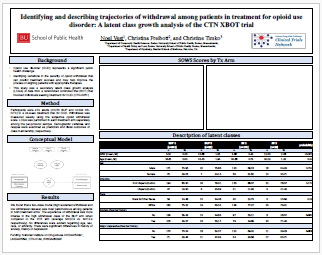 Opioid use disorder (OUD) represents a significant public health challenge. Identifying variations in the severity of opioid withdrawal that can predict treatment success and may help improve the process of aligning patients with appropriate therapies could help improve outcomes. This study was a secondary latent class growth analysis (LCGA) of data from a randomized controlled trial that involved individuals seeking treatment for OUD (CTN-0051). Participants were 474 adults (270 taking buprenorphine, 204 on extended-release naltrexone (XR-NTX)) in a 24-week trial for OUD. Withdrawal was measured weekly using the Subjective Opioid Withdrawal Scale. Analysis found that a two-class model (high sustained withdrawal and low withdrawal classes) was most parsimonious among patients in both treatment arms. The experience of withdrawal was more intense in the high withdrawal class of the BUP arm when compared to the XTR arm (average M=22.9 vs. M=12.4 respectively). No differences were evident regarding age, sex, race, or ethnicity. There were significant differences in history of anxiety and history of depression.
Related protocols: CTN-0051