Cocaine craving and use outcomes in a randomized study to test the safety and effectiveness of buprenorphine and naltrexone for the treatment of cocaine dependence.
 Cocaine craving is a core symptom of cocaine use disorder (CUD) and remains a consistent obstacle to achieving sustained reductions in use and relapse prevention. A systematic review examining pharmacological treatment for cocaine craving reported that in their review of 130 clinical trials, there was an association between craving and multiple cocaine use outcomes in most studies, including both self-report and biochemical evidence of use (i.e., urinary benzoylecgonine). Some studies have examined relationships between craving and treatment efficacy with opioid agonists and shown more mixed results.
This study aimed to examine the relationship between self-reported cocaine craving over time (i.e., 100mm Visual Analog Scale) and cocaine use over time (measured via urine drug screen and self-report) in a sample of patients receiving medication treatment for cocaine use disorder (from CTN-0148).
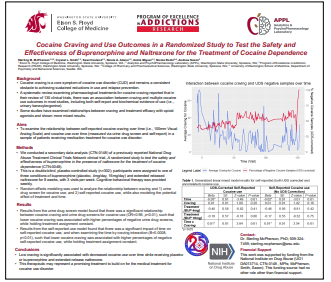
Results from the urine drug screen model found that there was a significant relationship between cocaine craving and urine drug screens for cocaine use (OR=0.98, p<0.01), such that lower cocaine craving was associated with higher percentages of negative urine drug screens, while holding treatment assignment constant. Results from the self-reported use model found that there was a significant impact of time on self-reported cocaine use, and when examining the time by craving interaction (B=0.0008, p<0.01), such that lower cocaine craving was associated with higher percentages of negative self-reported cocaine use, while holding treatment assignment constant.
Conclusions: Low craving is significantly associated with decreased cocaine use over time while receiving placebo or buprenorphine and extended-release naltrexone. This therapeutic may represent a promising treatment to build on for the medical treatment for cocaine use disorder.
Related protocols: CTN-0148