Opioid withdrawal and craving trajectories following buprenorphine taper: A latent class and growth mixture model of time-to-first opioid lapse.
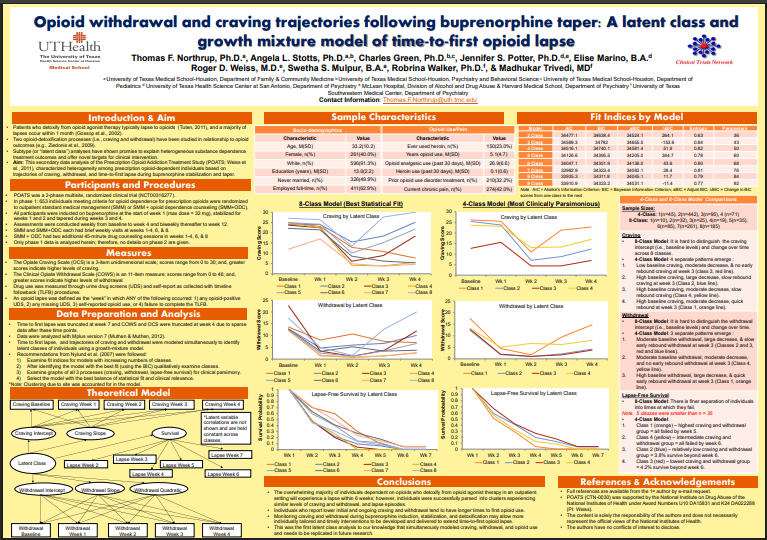 This study aimed to quantify the relations between craving and withdrawal symptoms and time to first opioid use among prescription opioid (PO) abusers undergoing buprenorphine detoxification. Higher indicators of craving and withdrawal at the outset of the taper were hypothesized to predict earlier user. Data from 653 PO-dependent individuals initiating a 14-day taper from buprenorphine/naloxone, recruited for the National Drug Abuse Treatment Clinical Trials Network protocol CTN-0030, were analyzed using survival analysis to explore time to first use as a function of opioid craving and withdrawal. Participants were collapsed across condition and measurements taken at the start of the taper were used. Participants were followed for 10 weeks after the taper began. PO craving was measured by 3 items on the Visual Analog Scale (VAS; e.g. “How much do you currently crave opiates?”) and opioid withdrawal was measured by the Clinical Opiate Withdrawal Scale and 1 item on the VAS. Withdrawal significantly predicted time to first use, such that each withdrawal unit increase led to a 1.0% decrease in time to first use. Craving items significantly predicted time to first use. Each unit increase on the craving item response scales was associated with a 1.7% to 1.9% decrease in time to first use, depending on the item. Further analyses revealed differences among individuals who terminated study involvement after the first taper and those willing to take part in a second taper.
Conclusions: Higher reports of withdrawal and craving at the outset of a buprenorphine taper are important clinical indicators of earlier lapse to opioids. Novel therapies to attenuate these effects are needed.
Related protocols: CTN-0030