Recurring themes identified by brief interventionists in an emergency department setting.
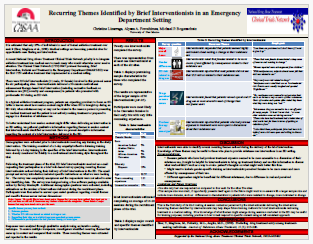 Interventionists (N=30, 11 male, 19 female) involved in the six-site National Drug Abuse Treatment Clinical Trials Network Screening, Motivational Assessment, Referral and Treatment in Emergency Departments (SMART-ED) protocol (CTN-0047) delivered 30-minute motivational enhancement therapy-based brief interventions (BI) to patients presenting with problematic substance use during an ED visit. Following the treatment phase of this study, we gathered information on themes in session content that interventionists identified as recurrent. This poster presents descriptive information regarding BI session content. Interventionists completed a survey that included questions on demographics, affiliated ED, and estimates of the number of interventions delivered. Respondents were asked to describe themes that stood out to them during their sessions as well as to list themes they noticed across different domains (e.g., gender differences). A qualitative approach was used to code and analyze responses. Twenty-one interventionists (70%) completed the survey. Respondents reported completing an average of 16-20 sessions during the trial. Five interventionists responded that patients seemed highly ambivalent about making a change in their substance use. Eight reported that most patients did not see their ED visit as related to their substance use. Fifteen interventionists found that patients viewed opioid and IV drug use as more severe/in need of change than marijuana use, although severity and consequences scores were roughly equivalent for these drugs classes. Four interventionists noted that females tended to be more aware of and affected by consequences related to their substance use, despite having lower rates of consumption. Finally, six interventionists reported that patients who had previous exposure to treatment were more open to discussions about their substance use.
Conclusions: Interventionists identified recurrent themes noticed during the delivery of the brief intervention. Knowledge of these themes may be useful to those providing substance use interventions in an ED setting.
Related protocols: CTN-0047