Determining measurement invariance in social work research.
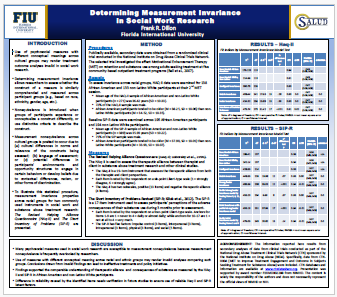 Use of psychosocial measures with different conceptual meanings across cultural groups may render treatment outcome analyses invalid in social work research. Determining measurement invariance allows researchers to assess whether the construct of a measure is similarly comprehended and measured across participant groups (e.g., based on race, ethnicity, gender, age, etc.). Nonequivalence is introduced when groups of participants experience or conceptualize a construct differently, or use distinctive criteria to describe the concept. Measurement nonequivalence across cultural groups is posited to occur due to (a) cultural differences in norms and relevance of the constructs being assessed; (b) language of assessment; or (c) potential differences in participants’ environments and opportunity structures to engage in certain behaviors or develop beliefs due to contextual differences, racism, or other forms of discrimination.
To illustrate this statistical procedure, this poster presents measurement invariance properties across racial groups for two commonly used instruments in social work and substance abuse treatment research (the Revised Helping Alliance Questionnaire (HAq-II) and the Short Inventory of Problems (SIP-R)), using data from the National Drug Abuse Treatment Clinical Trials Network protocol CTN-0004 (“Motivational Enhancement Treatment to Improve Treatment Engagement and Outcome in Subjects Seeking Treatment for Substance Abuse”). Analysis shows that use of measures with different conceptual meaning across racial and ethnic groups may render invalid analyses comparing such groups. Conclusions drawn from invalid findings can lead to ineffective treatments and policy initiatives.
Conclusions: Findings support the comparable understanding of therapeutic alliance and consequences of substance as measured by the HAq-II and SIP-R in African American and non-Latino white participants. Difference in reliability caused by the identified items needs verification in future studies to ensure use of reliable HAq-II and SIP-R latent factors.
Related protocols: CTN-0004