Economic evaluation of extended-release injectable naltrexone compared to buprenorphine-naloxone initiated in inpatient settings for treatment of opioid use disorder: Results derived from the X:BOT clinical trial.
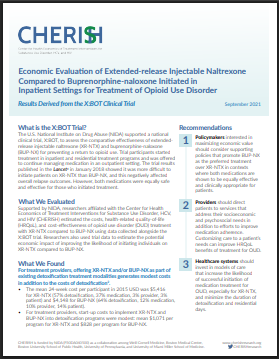 Investigators and colleagues associated with the Center for Health Economics of Treatment Interventions for Substance Use Disorder, HCV, and HIV (CHERISH) conducted primary and secondary economic analyses using data collected from the X:BOT trial (CTN-0051). They measured the cost, quality of life impact, and cost-effectiveness of initiating extended-release naltrexone (XR-NTX) and buprenorphine naloxone (BUP-NX) in inpatient and residential treatment programs.
This two-page factsheet provides an overview of the study and its findings and makes these recommendations:
- Policymakers interested in maximizing economic value should consider supporting policies that promote BUP-NX as the preferred treatment over XR-NTX when both medications are shown to be equally effective and clinically appropriate for patients.
- Providers should direct patients to services that address their socioeconomic and psychosocial needs in addition to efforts to improve medication adherence. Customizing care to a patient’s needs can improve HRQoL benefits of treatment for OUD.
- Healthcare systems should invest in models of care that increase the likelihood of successful initiation of medication treatment for OUD, especially for XR-NTX, and decrease the duration of detoxification and residential days.
Funding: NIDA supported the health economic analyses (R01DA035808) and dissemination activities (P30DA040500). The X:BOT trial was supported by the NIDA CTN (UG1DA013034; UG1DA013035; UG1DA013714; HHSN271201200017C; HHSN271201500065C; U10DA013045; U10DA013046; U10DA013714; U10DA015833).
Related protocols: CTN-0051