Craving intensity and withdrawal severity across phases of opioid detoxification with buprenorphine.
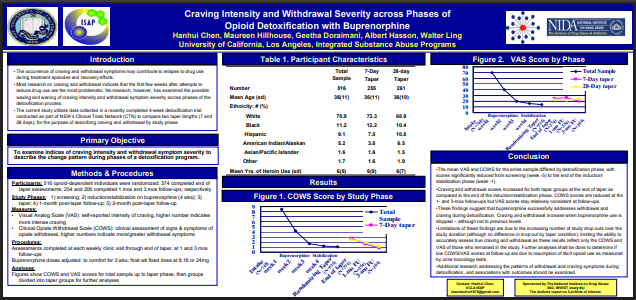 The occurrence of craving and withdrawal symptoms may contribute to relapse to drug use during treatment episodes and recovery efforts. Craving compels drug seeking behavior and withdrawal symptoms are a barrier to sustained abstinence. The current study examines indices of craving intensity and withdrawal symptom severity across time in a detoxification program, and addresses the association between craving and withdrawal symptom severity and drug use. The study analyzed data collected as part of protocol CTN-0003, a 28-day taper trial, using the Visual Analog Scale (VAS) to collect information on self-reported craving intensity and the Clinical Opiate Withdrawal Scale (COWS) to collect clinically observed withdrawal symptoms from 516 opiate-dependent study participants. Results demonstrate that patterns of craving and withdrawal occurred in parallel across the four weeks, with a sharp reduction in both craving and withdrawal symptoms from week 1 to week 2, followed by a slower reduction from week 2 to week 3. Both craving and withdrawal symptoms leveled out from week 3 to week 4. Understanding changes in craving and withdrawal across time in a detoxification program is useful in guiding clinical treatment plans, such as scheduled clinic visits and number of weekly behavioral sessions.
Related protocols: CTN-0003