Relationships between HIV disease knowledge, opinions, training, experience, and service availability at substance abuse treatment programs.
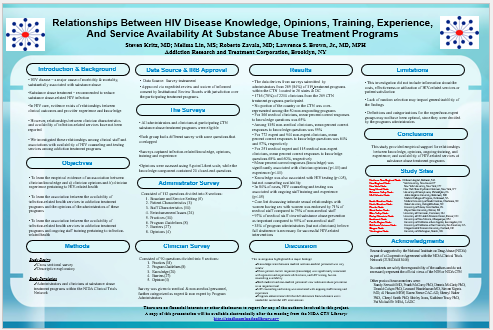 In HIV care, evidence exists of relationships between clinical outcome and provider experience, knowledge, and expertise. However, relationships between clinician characteristics and availability of infection-related services have not been reported. This investigation, related to protocol CTN-0012, surveyed administrators and clinicians at participating CTN substance abuse treatment programs to examine the relationships between clinician characteristics and availability of infection-related services. The surveys captured infection-related knowledge, opinions, training, and expertise. Results found that among 1350 non-medical clinicians, mean percent correct responses to knowledge questions was 53%. For 366 medical clinicians, mean percent correct responses to knowledge questions was 62%. Comfort discussing intimate sexual relationships with women having sex with women was endorsed by 79% of non-medical staff compared to 71% of medical staff, while 95% of non-medical staff viewed substance abuse prevention as important compared to 97% of medical staff. Mean percent correct responses was significantly associated with expertise and opinions of clinicians, and HIV testing, but not counseling availability. HIV counseling and testing was associated with ongoing staff training and experience, and the program administrators’ opinion regarding necessity of full abstinence to successful HIV-related interventions. In conclusion, this study provided empirical support for relationships between availability of infection-related services and staff training, experience, and administrator opinions in addiction treatment programs.
Related protocols: CTN-0012