Sociodemographic and clinical predictors of treatment retention and substance use outcomes.
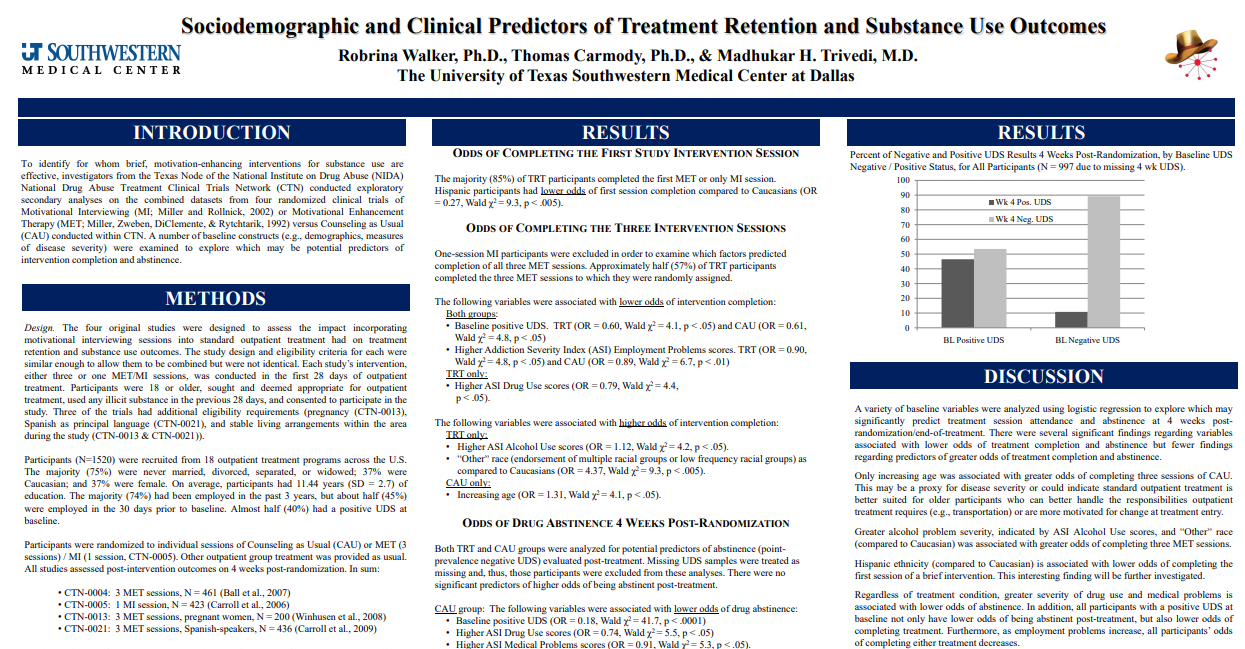 This poster describes a study that aimed to identify for whom brief, motivation-enhancing interventions for substance use are effective, using exploratory secondary analyses of the combined datasets from four randomized National Drug Abuse Treatment Clinical Trials Network protocols (CTN-0004, -0005, -0013, and -0021) examining Motivational Interviewing / Motivational Enhancement Therapy versus Counseling as Usual (CAU). Participants were randomized to individual sessions of CAU or MET (3 sessions) / MI (1 session, CTN-0005). Other outpatient group treatment was provided as usual. All studies assessed post-intervention outcomes 4 weeks post-randomization. Participants (N=1520) were recruited from 18 outpatient treatment programs across the U.S. The majority (75%) were never married, divorced, separated, or widowed; 37% were Caucasian; and 37% were female. Almost half (40%) had a positive UDS at baseline. The MET/MI (TRT; n = 741) and CAU (n = 779) conditions were collapsed across studies and both groups were analyzed separately using direct logistic regression. There were no specific hypotheses about the order or importance of the predictors. Hispanic participants had significantly lower odds of first session completion compared to Caucasians. In both groups, positive UDS at baseline and higher Addiction Severity Index (ASI) Employment Problems scores were significantly associated with lower odds of completing three sessions. For both the TRT and CAU groups, positive UDS at baseline, higher ASI Drug Use scores, and higher ASI Medical Problems scores were significantly associated with lower odds of abstinence at end-of-treatment. Results indicate clients most in need of drug use treatment (those who have used near treatment entry and have greater drug use, medical problem, and employment problem severity), are less likely to complete or benefit from outpatient treatment as usual or outpatient treatment with motivation enhancement. These results may indicate a higher level of care is more appropriate for clients with more severe drug use problems. Additional research is needed to determine if more MET sessions earlier in treatment can positively impact treatment attendance and abstinence outcomes.
Related protocols: CTN-0004, CTN-0005, CTN-0013, CTN-0021