Longitudinal opioid use in patients treatment with buprenorphine: A “missing not at random” (MNAR) and “missing at random” (MAR) growth model comparison.
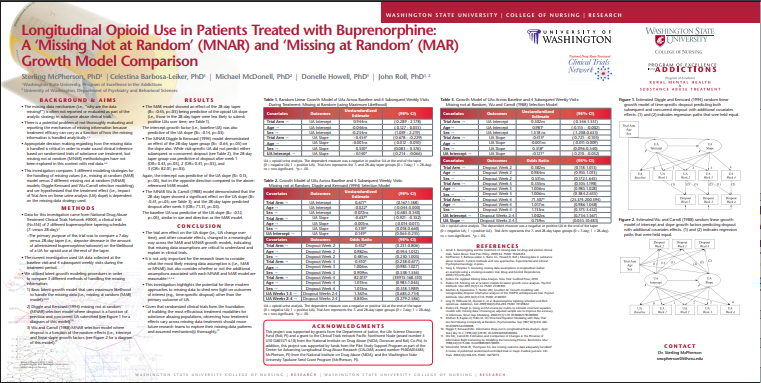 Because the analysis of a treatment’s efficacy can vary as a function of how the missing data in a substance abuse clinical trial is handled analytically, there is a potential problem of not thoroughly evaluating and reporting the mechanism of missing information as part of the analytic strategy. Appropriate decision-making regarding how the missing data is handled is critical in order to make sound clinical inference based on randomized trials of substance abuse treatment, but missing not at random (MNAR) methodologies have no been explored in this context with real data. This investigation uses data from protocol CTN-0003 to compare 3 different modeling strategies for the handling of missing values (i.e., missing at random (MAR) model versus 2 different missing not at random (MNAR) models; Diggle-Kenward and Wu-Carroll selection modeling), to determine whether the treatment effect (i.e., impact of trial arm on linear urine analysis (UA) slope) is dependent on the missing data strategy used.
Conclusions: The trial arm effect on the UA slope (i.e., UA change over time), and other covariate effects, changed in a meaningful way across the MAR and MNAR growth models, indicating that missing data assumptions are critical to understand and explain in clinical trials. It is not only important for the research team to consider what the most likely missing data assumption is (i.e., MAR or MNAR), but also to consider whether or not the additional assumptions associated with each MNAR and MAR model are reasonable. This investigation highlights the potential for these modern approaches to missing data to shed new light on outcomes of interest (e.g., time-specific dropout) other than the primary outcome of UA.
Related protocols: CTN-0003