The relationship between therapist and patient gender/race matching and substance use outcomes across two motivational enhancement therapy trials.
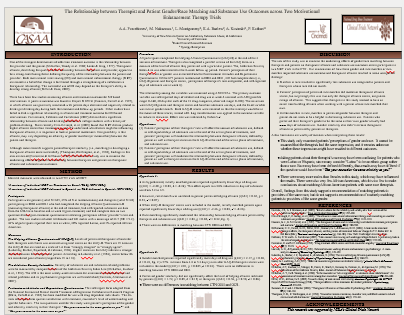 Although some research supports patient/therapist similarity in developing a therapeutic alliance more successfully, findings are mixed. The aim of this study was to examine the moderating effects of gender/race matching between therapists and patients on alliance and substance use outcomes. Identical measures were obtained in two CTN trials of MET (CTN-0004 and CTN-0021). Participants were patients (valid N=344) and therapists (valid N=24) participating in these trials who had complete data from the HAQ-II (measuring therapeutic alliance), ASI-Lite data at baseline and week 4 (post-treatment), and indicated perceptions of their provider’s race and gender on a post-treatment questionnaire. The authors hypothesized that patients’ perception of their therapists’ race and gender would (1) affect post-treatment substance use, and (2) moderate the relationship between therapeutic alliance, defined by patient and therapist scores on the HAQ-II, and substance use. The relationship among the variables was examined. Racially matched patients reported significantly fewer days of drug use. However, racial match was unrelated to patient perceived alliance. When HAQ-II therapists’ scores were included in the model, racially matched patients again reported significantly fewer days of drug use. Race matching significantly moderated the relationship between the alliance perceived by therapists and substance use. Gender matched patients reported significantly more days of drug use even after HAQ-II therapists’ scores were included in the model. Gender similarity did not significantly affect the level of alliance indicated by patients or therapists. In conclusion, findings from this study support racial, but not gender, matching.
Related protocols: CTN-0004, CTN-0021