Predictors of outcome in the multi-site CTN Prescription Opioid Addiction Treatment Study.
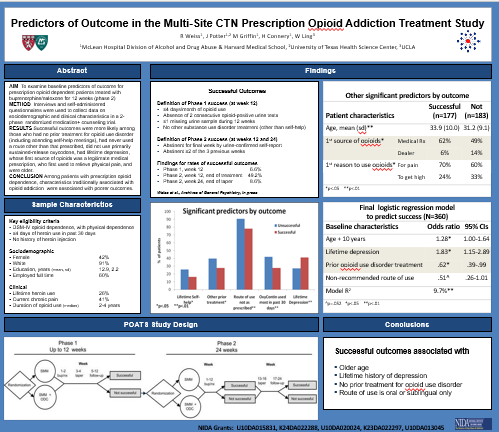 The ten-site Prescription Opioid Addiction Treatment Study (POATS), conducted as part of the National Drug Abuse Treatment Clinical Trials Network (CTN), examined different lengths of buprenorphine-naloxone (bup-nx) treatment with different intensities of counseling for patients dependent upon prescription opioids. The aim of the study described in this poster is to examine predictors of treatment outcome in this patient population. A two-phase adaptive treatment research designed examined outcomes: 1) during a brief taper and 2) while maintained on bup-nx for 12 weeks. “Successful outcome” was defined as abstinence in week 12 of Phase 2 (the last week of bup-nx stabilization) and greater-than/equal-to 2 of the previous 3 weeks (weeks 9-11). Sociodemographic and clinical characteristics were examined as predictors of successful outcome. Bivariate analyses revealed several predictors of successful outcome. Those who had never used heroin were more likely to achieve successful outcomes than those who had never used heroin (54% vs. 37%). Those reporting sustained-release oxycodone as the primary opioid used in the 30 days before baseline had fewer successful outcomes (41%) than did those who primarily used other opioids (58%). Those who had never attended self-help meetings had more successful outcomes than those who had ever done so (52% vs. 38%). Other predictors of successful outcome included major depressive disorder in the past year (64% of those with the diagnosis vs. 46% of those without) and being older (mean of 33.9 years vs. 31.2 years). The presence of chronic pain at baseline did not predict outcome. In conclusion: among patients with prescription opioid dependence, characteristics traditionally associated with addiction (use of heroin, absence of psychiatric illness, attendance at self-help meetings) were associated with poorer outcomes. Further examination of these variables may help to understand the interrelationships among them.
Related protocols: CTN-0030