Relationships between craving, quality of life, health satisfaction, and cocaine abstinence with the treatment effectiveness assessment in a sample of people with cocaine use disorder.
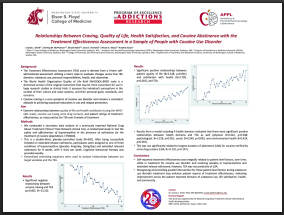 The Treatment Effectiveness Assessment (TEA) score is derived from a 4-item self-administered assessment utilizing a Likert scale to evaluate changes across four life domains: substance use, personal responsibilities, health, and citizenship. The World Health Organization Quality of Life Brief (WHOQOL-BREF) scale is a shortened version of the original instrument that may be more convenient for use in large research studies or clinical trials. It assesses the individual’s perceptions in the context of their culture and value systems, and their personal goals, standards, and concerns. Cocaine craving is a core symptom of cocaine use disorder and remains a consistent obstacle to achieving sustained reductions in use and relapse prevention.
This secondary analysis of data from CTN-0048 aimed to examine relationships between quality of life and health satisfaction (using the WHO-QOL scale), cocaine use (urine drug screens), and patient ratings of treatment effectiveness, as measured by the TEA over 8 weeks of treatment.
Results found significant negative relationships between cocaine craving and TEA and significant positive relationships between patient quality of life and satisfaction with health. A model including 4 health domains also indicated that there were significant positive relationships between health domains and TEA as well. TEA was not significantly related to longest duration of abstinence (LDA) for cocaine verified by urine drug screens.
Conclusions: Self-reported treatment effectiveness was integrally related to patient level factors, over time, while in treatment for cocaine use disorder and receiving placebo or buprenorphine and extended-release naltrexone, however TEA was not predictive of LDA. Recognizing and providing parallel intervention for these patient level factors during substance use disorder treatment may enhance patient reports of treatment effectiveness, indicating improvement across the patient reported domains of substance use, life satisfaction, health, and community.
Related protocols: CTN-0048