Barriers to providing health services for HIV/AIDS, hepatitis C virus infection, and sexually transmitted infections in substance abuse treatment programs in the United States.
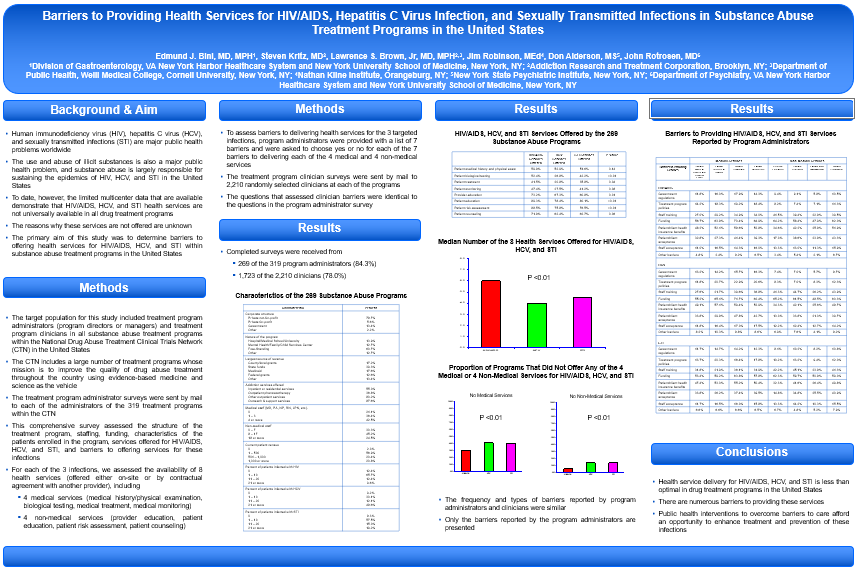 This poster describes the background and aims, methods, and outcomes of one facet of protocol CTN-0012 (“Characteristics of Screening, Evaluation, and Treatment of HIV/AIDS, Hepatitis C Viral Infections, and Sexually Transmitted Infections in Substance Abuse Treatment Programs”). The protocol examined the associations between HIV/AIDS, hepatitis C (HCV), and sexually transmitted infection (STI)-related services provided by substance abuse treatment programs in the National Institute on Drug Abuse Clinical Trials Network (NIDA CTN), and the states within which they are located.
This poster focuses specifically on the proportion of substance abuse treatment programs that did not offer health services for HIV/AIDS, HCV, and STI, and the identification of barriers to offering these services. Researchers conducted surveys of drug treatment program administrators and clinicians within the CTN to evaluate the availability of four medical services (medical history/physical examination, biological testing, medical treatment, and medical monitoring), four non-medical services (provider education, patient education, patient risk assessment, and patient counseling), funding, and other key elements involved in testing, evaluating, and caring for patients with HIV, HCV, and STI.
A high proportion of substance abuse treatment programs did not offer any of the four medical services either onsite or by referral. A lower proportion of programs did not offer any of the four non-medical services on-site or by referral. The most common barriers identified by program administrators and clinicians included funding, patient health insurance benefits, patient acceptance, and staff training, with funding identified as the single biggest obstacle to providing health services for these infections.
In conclusion, health service delivery for HIV/AIDS, HCV, and STI is less than optimal in drug treatment programs, and there are numerous barriers to providing these services. Public health interventions to overcome these barriers to care afford an opportunity to enhance treatment and prevention.
Related protocols: CTN-0012