-
News from the Pacific Northwest Node: Low-Dose Ketamine Reduces Fentanyl Withdrawal Symptoms
A new Addiction Science and Clinical Practice paper co-authored by Pacific Northwest Node researchers Crystal Smith and Cindy Grande describes a new, reliable strategy that allows fentanyl users to start treatment without prolonged suffering: low-dose ketamine. Fentanyl continues to cause the majority of drug overdoses in the U.S. Buprenorphine, a medication used to treat opioid use disorder (OUD), is effective and saves lives, but people often avoid it for fear of painful opioid withdrawal symptoms that can occur when starting the medication. The paper, published in early February, reports on a (non-CTN) study that found an extremely low intramuscular dose of ketamine before starting patients on buprenorphine led to a rapid and significant reduction of withdrawal symptoms in nearly all patients using fentanyl — with no side effects. Most patients could then immediately start buprenorphine without a return of withdrawal symptoms. In emergency departments, a high dose of ketamine, causing intense drowsiness, has been shown to reverse withdrawal symptoms after starting buprenorphine. This study was the first to find that an undetectably low dose of ketamine could both relieve fentanyl withdrawal and prevent renewed symptoms after starting buprenorphine. Read the paper, published in Addiction Science and Clinical Practice Posted on March 3, 2026
-
News from the Greater Intermountain Node: Join the Secondary Analysis SIG
Are you interested in expanding the impact of your CTN study or exploring new research questions using existing CTN datasets? The Secondary Analysis Special Interest Group (SIG) invites you to join our collaborative community! We welcome: Our group provides a supportive environment to discuss concepts, share methodologic insights, and develop high-impact secondary analyses that advance the CTN mission. If you are interested in presenting, collaborating, or attending our meetings, please contact Jerry Cochran (jerry.cochran@hsc.utah.edu) or Kristi Carlston (kristi.carlston@hsc.utah.edu) with the Greater Intermountain Node. We look forward to connecting with you and supporting the next wave of innovative CTN research. Posted on February 18, 2026
-
News from the Appalachian Node: GLP-1s for Addiction
Sarah Kawasaki, MD, Co-Investigator of the CTN Appalachian Node was quoted in a recent New Yorker article entitled, “Can Ozempic Cure Addiction?“ GLP-1 medications like Ozempic mimic a naturally occurring hormone called glucagon-like peptide 1, which scientists have historically associated with digestion. But it’s increasingly clear that GLP-1 affects much more than eating, and these medications are now being studied as potential treatments for a number of conditions, including addiction. (There are currently two CTN trials involving GLP-1 medications: CTN-0152 and CTN-0153.) Sarah Kawasaki, chief of addiction services at Penn State Health, collaborated on a human trial for opioid addiction in which a GLP-1 was being tested on 20 people at a residential treatment center. The results were promising: 10 people received the medication and 10 received a placebo; people on the GLP-1 medication (liraglutide) reported 40% fewer cravings. Now Kawasaki is helping lead a trial of hundreds of people with opioid addiction, living in a community rather than a treatment center, and they are on multiple medications: semaglutide (a GLP-1), as well as either methadone or buprenorphine. Check out the complete New Yorker article here! (free version for non-subscribers) Posted on February 18, 2026
-
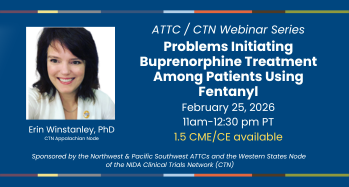
Western States Node Webinar: Problems Initiating Buprenorphine Treatment Among Patients Using Fentanyl (Feb 25, 2026) CME available!
Join the CTN Western States Node and the Northwest and Pacific Southwest Addiction Technology Transfer Centers (ATTCs) for their next joint webinar, February 25, 2026, 11am-12:30pm PT! In this session, Erin Winstanley, PhD (CTN Appalachian Node), will describe a NIDA Clinical Trials Network study, CTN-0135, examining clinician-reported challenges with initiating buprenorphine for people using fentanyl, including precipitated or prolonged withdrawal, patient reports that buprenorphine was ineffective, and patient preference for methadone. In response to these challenges, most clinicians surveyed reported modifying their standard induction protocols or patient counseling approaches. Clinicians treating larger patient volumes, seeing a high proportion of patients using fentanyl, or initiating treatment in non-inpatient settings were more likely to report difficulties starting patients on buprenorphine. Dr. Winstanley will present the study results and discuss their implications. 1.5 CME/CE available! For information about credit types and accreditation, as well as learning objectives for this session, download the webinar flyer. Register for the webinar here! Posted on February 11, 2026
-
News from the Northeast Node: Innovations in OUD Treatment webinar (Feb. 26, 12pm ET)
Join the CTN Northeast Node for the next installment of their long-running Science Series: Innovations in Opioid Use Disorder Treatment February 26, 2026, 12-1pm ETPresenter: Sarah Wakeman, MD This session will review changes in the opioid overdose crisis and innovations in opioid use disorder treatment, including novel approaches to initiating buprenorphine, use of long-acting injectable buprenorphine, and strategies for methadone initiation in general medical settings. Register for the Science Series session here! Posted on January 27, 2026
-
News from the Appalachian Node
The CTN-0135 Aim 2 manuscript has been published in JAMA Open Network: Kawasaki SS, Liebschutz JM, Murray-Krezan C, Switzer GE, Nash S, Jeong K, Winstanley EL. Barriers to Buprenorphine Initiation in Patients Using Fentanyl. JAMA Netw Open 2026 ;9(1):e2552136. doi: 10.1001/jamanetworkopen.2025.52136. PMID: 41490107; PMCID: PMC12771233. Find it in the CTN Dissemination Library The Appalachian Node will be facilitating a symposium at the 2026 annual meeting of the College on the Problems of Drug Dependence (CPDD) [June 13-17 in Portland, Oregon] on science communication. Our symposium will summarize multimedia strategies we are using to effectively disseminate scientific findings and to engage communities. This will include the results of an evaluation of a data dashboard developed to visualize the results of CTN-0135 (Aim 2 survey). Posted on January 21, 2026
-
News from the Ohio Valley Node: CTN-0152 Opens for Recruitment!
The CTN-OVN has successfully led pre-initiation activities for the CTN-0152 (TAB; LI – Winhusen) study, and the first two sites are now open for participant recruitment. TAB is a double-blind, randomized, placebo-controlled, intent-to-treat trial designed to evaluate the effect of weekly subcutaneous (SQ) tirzepatide versus placebo as an adjunct to buprenorphine maintenance treatment (BUP) for opioid use disorder. Approximately 310 participants who have recently initiated BUP will be randomized across 10 study sites. Congratulations to the study teams at Vanderbilt University Medical Center (Nashville, TN) and West Virginia University Medicine Healthy Minds – Chestnut Ridge (Morgantown, WV) for being the first two sites to open for recruitment! Posted on December 18, 2025
-
News from the New York Node: Annual Meeting Convened
The NY Node held a full-day in-person meeting in New York City on Oct. 17, 2025. The annual meeting brought together more than 90 participants from New York, New Jersey, and Maryland. The goal of the meeting was to understand clinical and research priorities of service providers and public health partners, identify key areas for collaboration, and shape the Node’s research agenda within the national CTN. Attendees represented major health systems and FQHCs, governmental and public health agencies, community-based treatment and low barrier programs, and academic trainees and investigators. The program started with an overview of the NY Node and CTN, followed by three panels: (1) SUD Health Services Perspectives; (2) Low-Barrier Treatment and Research Collaborations; and (3) Research Priorities for Co-Occurring Mental Health and Substance Use Disorders. Afternoon breakout sessions and a large-group discussion focused on research priorities and strategies to improve substance use care. The meeting provided a wonderful opportunity to connect with colleagues and share ideas. We look forward to our 2026 meeting and continuing to build collaborations to advance research within the CTN. Posted December 12, 2025.
-
News from the Greater Intermountain Node: CTN-0151, Podcast, Last Call for JSAT Special Issue
CTN-0151 at AMERSA 2025 CTN-0151 was featured at the Association for Multidisciplinary Education and Research in Substance Use and Addiction (AMERSA) 2025 conference with the poster: “Stakeholder Perspectives on Community Pharmacists’ Prescribing and Management of Buprenorphine for Opioid Use Disorder Under a Collaborative Pharmacy Practice Agreement,” presented by Greater Intermountain Node Clinical Research Coordinator, Melissa Tysko. The poster highlighted CTN-0151’s goal to develop a model for community pharmacist-managed buprenorphine for opioid use disorder. As part of the study, researchers conducted qualitative interviews with stakeholders in community pharmacy and MOUD treatment—including pharmacists, physicians, patients, recovery support organizations, and payors. Interviews were analyzed using the Consolidated Framework for Implementation Research. Findings showed strong support across stakeholder groups for this model of care, emphasizing its potential to reduce provider workload and improve patient access to treatment. Key considerations for implementation included adaptability, integration into existing pharmacy workflows and technology, and strategies to measure performance and care quality. Let’s Talk About Drugs in the Intermountain West Podcast Our node’s umbrella program, the Program of Addiction Research, Clinical Care, Knowledge, and Advocacy (PARCKA), hosts a weekly podcast: Let’s Talk About Drugs in the Intermountain West (LTAD). Each episode offers fresh conversations about addiction and highlights efforts to address substance use disorders in the Greater Intermountain West. Starting January 7, 2026, LTAD will launch a special 12-week series titled “Use With Care,” focused on overdose prevention and harm reduction. This series will feature local experts and advocates discussing topics such as harm reduction 101, safer…
-
News from the PNW Node: Dr. Andy Saxon Receives AAAP Outstanding Achievement & Service Award
Long-time Pacific Northwest Node member Andy Saxon, MD is the recipient of the 2025 Outstanding Achievement and Service Award from the American Academy of Addiction Psychiatry (AAAP). This honor is presented to an outstanding member of the community who works in the field of addiction and who has contributed significantly to the science, teaching, treatment, and/or advocacy related to substance use disorders and co-occurring mental illness. Before his entry into psychiatry, Dr. Saxon completed an internal medicine internship and worked for four years as an emergency room physician. Following a general psychiatry residency at UW, Dr. Saxon has more than four decades of experience as a clinical and research addiction psychiatrist. He sits on the editorial boards of the journals, Drug and Alcohol Dependence and General Hospital Psychiatry. He is a lifetime Distinguished Fellow of the American Psychiatric Association, where he served as the chair of the Council on Addiction Psychiatry from 2017-2019. He’s a fellow of the American Society of Addiction Medicine, as well as a member of College on Problems of Drug Dependence and of the American Academy of Addiction Psychiatry. He has given numerous presentations at conferences and has more than 200 papers published in peer reviewed journals. Congratulations, Dr. Saxon!