-
News from the Greater Intermountain Node: 2026 AHSR Conference
Our team was delighted to welcome researchers, treatment providers, healthcare professionals, and colleagues from across the country to the 2026 Addiction Health Services Research (AHSR) Conference in Salt Lake City. It was especially wonderful to reconnect with so many Clinical Trials Network investigators and partners, catch up with longtime collaborators, and meet new colleagues committed to advancing addiction science and care. Together, attendees explored opportunities to address inequities, improve access to care, strengthen treatment effectiveness, and advance evidence-based addiction services. Thank you to everyone who shared their knowledge, ideas, and experiences. The passion, innovation, and collaborative spirit on display throughout the conference were inspiring, and we look forward to continuing this important work together. Posted on October 20, 2026
-
News from the Appalachian Node: Upcoming AMERSA Presentations
Posted on October 20, 2026
-
News from the Greater Intermountain Node
Community Outreach for Recovery Month! This September, the Greater Intermountain Node team is celebrating Recovery Month by participating in community events across Utah. At First Step House, we connected with residents at an Ice Cream Social (left) and hosted booths at Utah Support Advocates for Recovery Awareness (USARA) Recovery Days events (right). We appreciate the chance to meet community members, share information, and support recovery-focused events throughout Utah! Shauna Filion joins ASAM PWLE Board! We are pleased to recognize Shauna Filion, Certified Lead Medical Assistant and GIN’s CIRCL representative, for her selection to the American Society of Addiction Medicine (ASAM) panel of individuals with lived and living experience with substance use disorders and incarceration. In this role, Shauna will contribute to the development of ASAM’s clinical criteria for the treatment of individuals with substance use disorders in prison and jail settings and during reentry. Her perspectives and input will help inform treatment standards and identify key topics that shape this work. Shauna’s involvement reflects the mission of CIRCL, which promotes meaningful collaboration between researchers and people with lived experience to strengthen the relevance, quality, and impact of addiction research. We appreciate her contributions and are pleased to see her representing both GIN and CIRCL in this important effort. Posted on September 18, 2026
-
News from the Health Systems Node: Webinar on MOUD During Critical Illness (Oct. 1, 2026, 10am PT)
Join the Health Systems Node on October 1, 2026 (10am PT, 1pm ET) for their next virtual seminar featuring Ryan JJ Buckley, MD, MPH, MHS, Assistant Professor of Emergency Medicine and Medicine at Yale School of Medicine. In MOUD During Critical Illness: What We Know, What We’re Finding, and Where We’re Headed, Dr. Buckley will review current evidence on medications for opioid use disorder (MOUD) in intensive care settings, share preliminary findings from ongoing studies of ICU practice patterns, and discuss efforts to develop a protocolized ICU MOUD intervention for future clinical trial testing. Please join us for this timely discussion of gaps—and emerging opportunities—in addiction care during critical illness. How to join: Click Join the meeting now to connect through Microsoft Teams. If prompted, enter Meeting ID 250 658 877 216 6 and Passcode B8jq2m9A. To join by phone, call +1 213-533-9530 and enter Phone Conference ID 508 786 770#. Posted on September 17, 2026
-
News from the New England Consortium Node & CTN-0100/RDD Update
At the CTN Quarterly Steering Committee Meeting on September 15, 2026, NECN member, Zoe Weinstein, MD, MS, co-led the final study report for the CTN-0098 along with study Co-Lead Investigator, Gavin Bart, MD, PhD, FACP, FASAM. Dr. Weinstein serves as the Site PI for the Boston University site for both CTN-0098A and CTN-0098B. NECN member, Richard Saitz, MD, MPH, FACP, DFASAM, study Co-Lead Investigator, passed away during the study, and he was acknowledged and honored as a leader and innovator of the study. CTN-0100/RDD study update This publication from the CTN-0100 RDD Study has over 3,000 views! Research ethics in stopping opioid use disorder medication [editorial].Weiss, Roger D.; Nunes, Edward V.; Provost, Scott E. JAMA Psychiatry 2026;83(5):439-440. Find it in the CTN Dissemination Library The CTN-0100 primary outcome paper for the Retention Phase is in preparation. Posted on September 17, 2026
-
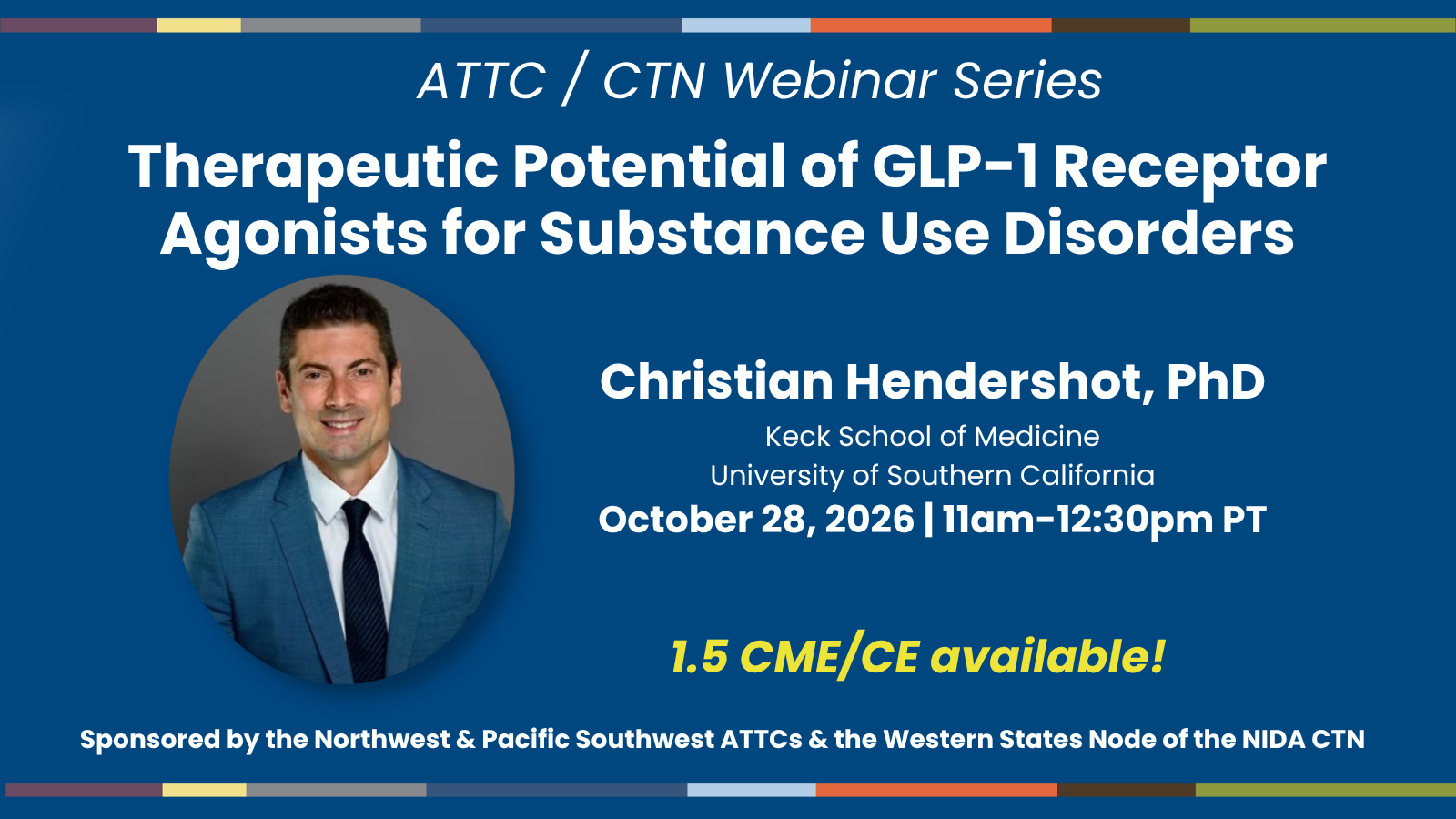
Western States Node Webinar: Therapeutic Potential of GLP-1 Receptor Agonists for Substance Use Disorders (Oct. 28, 11am PT)
Presenter: Christian Henderson, PhD, Keck School of Medicine, University of Southern California (read more about Dr. Henderson here) This presentation will summarize emerging evidence for the efficacy of GLP-1 receptor agonists for substance use disorders. Recent and ongoing Phase 2 clinical trials will be reviewed, and key clinical and implementation issues discussed. After this session, participants will be able to: 1.5 CE/CME available! Sponsored by the Northwest and Pacific Southwest ATTCs and the Western States Node of the NIDA Clinical Trials Network. About the presenter Christian Hendershot, PhD, is Professor of Population and Public Health Sciences and Psychiatry and the Behavioral Sciences at the Keck School of Medicine, University of Southern California, and Director of Clinical Research at the USC Institute for Addiction Science. His research utilizes clinical, cognitive, neuroscience and psychopharmacology methods to study the etiology and treatment of substance use disorders. His recent work has included early Phase 2 trials of incretin therapies for substance use disorder, including NIDA-funded projects evaluating the efficacy of GLP-1 receptor agonists for cigarette smoking. This session is sponsored by the CTN Western States Node and the Northwest and Pacific Southwest ATTCs. Register here! Posted on September 16, 2026.
-
Northeast Node Webinar: Using AI and Passive Data to Improve Digital Assessment and Treatment of Substance Use and Mental Health Disorders (Sept. 24, 2026, 12pm ET)
Join the Northeast Node for the next installment of their Science Series: Using AI and Passive Data to Improve Digital Assessment and Treatment of Substance Use and Mental Health Disorders (September 24, 2026, 12-1pm ET). Presented by Nicholas C. Jacobson, PhD. Dr. Jacobson, PhD, is an Associate Professor of Biomedical Data Science and Psychiatry at Dartmouth’s Geisel School of Medicine, where he directs the AI and Mental Health: Innovation in Technology Guided Healthcare (AIM HIGH) Laboratory. He has published over 130 peer-reviewed papers (H-index: 44), with a large portion focused on using passively collected smartphone and wearable sensor data to detect psychiatric disorders, measure symptom severity, and predict real-time changes in mental health. His work spans data from over 10,000 participants across 100+ countries. In this talk, he will cover how these digital phenotyping methods have been applied within the CTN through the D-TECT study (CTN-0084-A2), his lab’s personalized digital therapeutics for co-occurring anxiety, depression, and substance use disorders, and the 6.5-year development of Therabot, a generative AI psychotherapy chatbot. Therabot was tested in the first randomized controlled trial of generative AI psychotherapy, published in the New England Journal of Medicine AI, where 210 participants showed large symptom reductions (d=0.63 to 0.90) and averaged over 6 hours of engagement across 24 days. He will close with implications for substance use treatment research. Register here Posted on August 31, 2026.
-
News from the New York Node: CTN-0155 Launches Recruitment
CTN-0155 (Project BISTRO) has officially launched recruitment as of August 17, 2026! After many difficult but inspiring months of planning, training, and imagining a new approach to high-quality, person-centered, community-based opioid use disorder (OUD) treatment, we have launched Project BISTRO (Buprenorphine Implementation at SSPs to Reduce Overdoses). Eight (8) pioneering syringe services programs (SSPs) from across the United States are participating in the study and will build capacity to provide onsite buprenorphine treatment. Our team also includes researchers from CTN’s New York Node, Florida Node Alliance, and Appalachian Node, the Emmes Clinical Research Organization, a community advisory board, and partners at the National Institute on Drug Abuse. All 8 Sites have officially been endorsed. The first screening visit officially took place on August 18, 2026. Recruitment will continue for 16 months. The study team is excited to reach this important milestone and looks forward to updating the CTN community on the study’s progress. For questions or comments, please contact the study team at: ctnbistro0155@nyspi.columbia.edu Posted on August 21, 2026
-
News from the Greater Intermountain Node
AHSR 2026 The 2026 Addiction Health Services Research (AHSR) Conference will be held October 5-7, 2026, in Salt Lake City, Utah, home of the Greater Intermountain Node. The conference brings together addiction researchers, policymakers, and treatment providers to discuss challenges and opportunities related to equity, access, effectiveness, and implementation of addiction services. Early bird registration ends September 4, 2026. Register by that date to save $100. The conference hotel is likely to sell out, so early booking is recommended. Visit the AHSR 2026 website Save the Date for the CTN Steering Committee Meeting Our Staff Retreat Our annual staff retreat was an action-packed visit to the Game Show Battle Rooms, where we faced off in games inspired by fan favorites like The Price Is Right, Wheel of Fortune, and more, bringing plenty of laughs, suspense, and excitement along the way. We left feeling energized, motivated, and even more connected as a team! Posted on August 21, 2026
-
News from the Health Systems Node: Virtual Seminar September 3, 2026 (10am PT)
Join the CTN Health Systems Node for an upcoming virtual seminar: On Thursday, September 3, 2026 (10am PT, 1pm ET), Tessa Matson, PhD, MPH, Collaborative Scientist at Kaiser Permanente Washington Health Research Institute, will present findings from a CTN implementation trial on factors that distinguished clinics that successfully increased opioid use disorder treatment from those that did not. Connect via Microsoft Teams. Meeting ID: 250 658 877 216 6 | Passcode: B8jq2m9A.