-
NIDA Drug Repurposing and Repositioning Insights for Treating Substance Use Disorders Challenge
The NIDA “Drug Repurposing and Repositioning Insights for Treating Substance Use Disorders (SUDs)” Challenge aims to inspire and gather groundbreaking ideas for repurposing or repositioning existing drugs to effectively treat substance use disorders. By focusing on existing drugs, new therapeutic approaches can rapidly be translated into clinical practice, bringing new hope to individuals struggling with SUD. The Challenge will offer up to ten awards of up to $10,000 each. The Challenge total cash prize purse is up to $100,000. Challenge participants and winners may also have the opportunity to collaborate with the center focused on drug repurposing that NIDA anticipates funding in the future. The submission deadline for this Challenge competition is January 8, 2025, so learn more and submit your solution today! Learn more and apply here!
-
New in the Library (November-December 2024)
Here are the latest items added to the CTN Dissemination Library for November-December 2024 (this post will be updated as new items come in): Factors Associated with PrEP Awareness and Use Among Men Who Have Sex with Men Who Use Drugs in the Southern United States. Paschen-Wolff M, et al. AIDS Care 2024 (in press). (CTN-0082) Efficient and Flexible Mediation Analysis with Time-Varying Mediator, Treatments, and Confounders. Díaz I, Journal of Causal Inference 2023;11(1):20220077. (CTN-0051) Pharmacy-Based Preventive Services for Opioid Use Disorder: A Survey of U.S. Pharmacists. Wu L, et al. Addiction Science & Clinical Practice 2024;19:88. (primary outcomes for CTN-0105) CTN-0138: Adaptation, Implementation, and Cluster Randomized Trial of a Community Pharmacy-Based Prescription Drug Monitoring Program Opioid Risk Assessment Tool — A Protocol Paper. Cochran GT, et al. Addiction Science & Clinical Practice 2024;19:82. (CTN-0138) Artificial Intelligence-Based Drug Repurposing with Electronic Health Record Clinical Corroboration: A Case for Ketamine as a Potential Treatment for Amphetamine-Type Stimulant Use Disorder. Gao Z, et al. Addiction 2024 (in press). (CTN-0114) Posted November 18, 2024, updated December 18, 2024
-
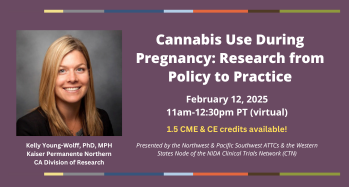
Western States Node/ATTC Webinar: Cannabis Use During Pregnancy: Research from Policy to Practice (Feb 12, 11am PT)
In this webinar sponsored by the Western States Node and the Northwest and Pacific Southwest ATTCs, Kelly Young-Wolff, PhD, MPH (a licensed clinical psychologist and research scientist at the Kaiser Permanente Northern CA Division of Research) will describe what is known about prenatal cannabis use trends and health consequences using data from Kaiser Permanente Northern California’s large integrated healthcare delivery system. She will discuss why pregnant individuals use cannabis, describe disparities in prenatal cannabis use and related outcomes, and end with a discussion about the potential harms of punitive policies that penalize or criminalize prenatal substance use. At the conclusion of the webinar, participants will be able to: 1.5 CME or CE credits available! (Select credit type when you register; learn more about available credit types here) Sponsored by the Northwest and Pacific Southwest Addiction Technology Transfer Centers (ATTCs) and the Western States Node of the NIDA Clinical Trials Network. Learn more and register here!
-
Youth SIG Webinar: Age, Period, and Cohort Effects in Alcohol and Other Substance Use (Jan 17, 11am ET)
Join the CTN Youth SIG for their next webinar, “Age, Period, and Cohort Effects in Alcohol and Other Substance Use: Implications for Health and Prevention,” presented by Katherine M. Keyes, PhD (Columbia University), on Friday, January 17, 2025, 11am-12pm ET. Incidence, prevalence, and persistence of substance use differ by generation and by substance. Understanding how each generation uses alcohol and other drugs, why, and how health is implicated is critical for public health. The presentation will overview what we know about current trends in substance use, how rates are organized by age, period, and cohort, and how these trends are shaping public health overall. About the presenter Katherine M. Keyes, PhD, is Professor of Epidemiology at the Columbia University Mailman School of Public Health. Dr. Keyes’ research focuses on psychiatric and substance use epidemiologyacross the life course, including early and cross-generational origins of child and adult health and cohort effects on substance use, mental health, and injury outcomes including suicide and overdose. She is the author of more than 450 peer-reviewed publications, and two textbooks. Register here!
-
CTN Primary Care SIG Webinar: Engaging Rural Communities and Practices in Substance Use Research (Jan. 27, 12pm ET)
The NIH recently launched a $30 million Communities Advancing Research Equity (CARE) for Health Initiative, which funds primary care research network hubs to engage rural communities and practices in research. As part of the pilot, CTN-0139 (Co-Care) is engaging with two newly funded rural hubs to expand engagement and recruitment in small rural practices. The January 27, 2025 Primary Care SIG meeting (12pm ET, 9am PT) will feature a panel to discuss how CARE for Health synergistically can enhance and contribute to CTN trials. The panel will include: Connect to the Zoom meeting.ID: 996 0835 1363Passcode: 291918 Questions? Contact Maria Prado at pradom@uw.edu.
-
Recording available: NIDA CTN: Future of AI in Medicine: Medical Imaging as an Example
A recording of this webinar, held on November 20, 2024, is now available! (passcode: N7A3h^SX) Presenter:Dr. Curt LanglotzProfessor of Radiology, Medicine, and Biomedical Data ScienceSenior Associate Vice Provost for ResearchDirector, Center for Artificial Intelligence in Medicine & ImagingSenior Fellow, Institute for Human-Centered Artificial Intelligence Artificial intelligence (AI) is an incredibly powerful tool for building systems that support the work of clinicians and researchers. Over the last decade, machine learning methods have revolutionized the analysis of medical data, leading to high interest and explosive growth in the use of AI and machine learning methods. These promising techniques create systems that perform some clinical tasks at the level of expert physicians. Deep learning methods in imaging are now being developed for image reconstruction, imaging quality assurance, imaging triage, computer-aided detection, computer-aided classification, and radiology report drafting. The systems have the potential to provide real-time assistance to radiologists and other imaging professionals, thereby reducing diagnostic errors, improving patient outcomes, and reducing costs. We will review the origins of AI and its applications to medicine, and medical imaging, define key terms, and show examples of real-world applications that suggest how AI may change the practice of medicine. We will also review key shortcomings and challenges that may limit the application of these new methods. About the presenter Curtis P. Langlotz, MD, PhD : Dr. Langlotz is Professor of Radiology, Medicine, and Biomedical Data Science, and Senior Associate Vice Provost for Research at Stanford University. His NIH-funded laboratory develops machine learning methods to improve the accuracy and…