-
CPDD 2026: Submit your abstracts to the Publications Committee ASAP!
Submissions of abstracts for posters and oral presentations are now open for CPDD 2026, which will be held in Portland, Oregon from June 13-17, 2026. The CPDD Submission Deadline is December 4. All abstracts must be approved by the CTN Publications Committee prior to submission to CPDD. Please submit CPDD abstracts to the PC as soon as possible for review to facilitate approval prior to the Thanksgiving holiday. Submit your abstracts to Jack Blaine (jblaine@nih.gov) and Susan Sonne (sonnesc@musc.edu).
-
News from the Health System Node: INEBRIA presentation, Prenatal cannabis use, Upcoming webinar
Stacy Sterling, DrPH, MSW, MPH, and Derek Satre PhD, Health System Node faculty, hosted the International Network on Brief Intervention for Alcohol or Other Drugs (INEBRIA) conference in San Francisco, CA on September 24-26, 2025. INEBRIA is dedicated to evaluating the effectiveness of brief interventions in different settings with different types of patients. A great turn out, with more than 130 researchers from around the world in attendance. Research by Kelly Young-Wolff, PhD, MPH, Health System Node faculty, and Research Scientist at the Kaiser Permanente Northern California Division of Research, was highlighted in the new ACOG guidelines on prenatal cannabis use. Upcoming online seminar The new Health Systems Node Seminar Series presents Lessons Learned About Treating Co-occurring Conditions Among Adults Receiving Substance Use Disorder Treatment with Dr. Mark Ilgen, PhD. Join us for online seminar on November 6, 2025 @ 10 am PT. No registration required. Contact Morgan Ford for more information: morgan.ford@kp.org. Website/link to join:Join the Microsoft Teams Meeting hereMeeting ID: 250 658 877 216 6Passcode: B8jq2m9A Description: Co-occurring mental health and physical problems are common among patients receiving treatment for substance use disorders. When present, these issues typically predict poorer functional and substance-related outcomes following treatment. This suggests that addressing co-occurring problems during an episode of substance use disorder treatment could significantly improve a wide range of outcomes. However, prior studies have yielded somewhat inconsistent results regarding the additional and/or synergistic benefits of treating co-occurring mental health and physical problems beyond the standard effects of substance use…
-
News from the Greater Southern California Node: New Publication
The Greater Southern California Node has a new publication out about CTN-0143 (Social Determinants of Health: Needs and Consequences Associated with Substance Use Disorders): A scoping review of interventions addressing social determinants of health and their influence on opioid use disorder outcomes. Cousins SJ, et al. Drug and Alcohol Dependence 2025;276:112858. Over the past decade, opioid overdose deaths have risen sharply. The Social Determinants of Health (SDOH) framework can guide interventions to improve opioid use disorder (OUD) outcomes. Understanding which SDOH-focused interventions work — and how they affect OUD — can help meet the needs of people at risk or living with OUD. This scoping review looked at SDOH interventions and their impacts on OUD outcomes across five domains. Most focused on the healthcare system (37%), improving provider training, access, and care quality. Others addressed community and social context (30%) through support programs and coalitions; economic stability (16%) via employment and financial incentives; neighborhood environment (9%) through Housing-First models; and education (2%) with early prevention programs. These efforts generally reduced opioid use, overdoses, and stigma. However, inconsistent SDOH definitions and limited rigorous evaluation hinder clear conclusions. Strengthening study design and measurement is crucial to advance effective SDOH-based OUD interventions. Read the full paper here! (free full text) Posted on October 14, 2025
-
New in the Library (September-October 2025)
Here are the latest items added to the CTN Dissemination Library for September – October 2025 (this post will be updated as new items come in): A scoping review of interventions addressing social determinants of health and their influence on opioid use disorder outcomes. Cousins SJ, et al. Drug and Alcohol Dependence 2025;276:112858. (CTN-0143) Leadership and team effectiveness for implementation in children’s mental health. Aarons G. Youth Special Interest Group (SIG) webinar, September 2025. Clinical decision support to increase provision of opioid use disorder services in primary care. Rossom R, Hooker S, Bart G. Webinar from the CTN Translation & Implementation SIG, September 2025. Posted October 8, 2025, updated October 13, 2025
-
News from the Southern Consortium Node: Dr. Brady, one of Charleston, SC’s Most Influential People!
Dr. Kathleen Brady, principal investigator of the CTN Southern Consortium Node, was recently named one of the top most influential people in Charleston, South Carolina, by Charleston Magazine! From the article: The Researcher: Kathleen Brady, MD Medical research is that nerdy enterprise most of us don’t pay attention to, until we need it. Given that nearly 17% of Americans over age 12 faced a substance [use] disorder in the last year, chances are you’ll need it. Enter Dr. Kathleen Brady, vice president for research and distinguished professor and MUSC [Medical University of South Carolina], where for more than three decades, she’s led the charge for evidence-based treatments, studying how anxiety, affective disorders, and PTSD affect addiction, particularly in women. Brady has been the top NIH-funded investigator at MUSC and in the top five percent nationally for over a decade, receiving the SC Governor’s Award for Excellence in Science for her contributions, including ensuring clinical trial discoveries reach frontline providers. “I’m committed to science and research, but my interest lies in how these improve the lives of patients,” the Betty Ford Award recipient said. That bridge proved vital when the opioid crisis hit South Carolina. Brady’s work has expanded treatment capacity, including telehealth, screening, and ER intervention for opioid addiction throughout the state, saving countless lives. Congratulations, Dr. Brady! Read the piece from Charleston Magazine here (Dr. Brady is #43 in the list) Posted on October 13, 2025
-
News from the Pacific Northwest Node: October Retreat and Art Break!
The CTN Pacific Northwest Node team took some time out on October 2nd and 3rd to do some goal-setting for the coming year. As a reward for all their hard work, they participated in a Paint and Sip at Canvas in Redmond, funded by a University of Washington School of Medicine Well Being grant! Check out the incredible artwork of this multi-talented Node team! Pictured: (Back, left to right) Kai Orozco, Brenda Stuvek, Michelle Ingalsbe, Mary Hatch(Front, left to right) Tanja Laschober, Sharon Garrett Posted on October 13, 2025
-
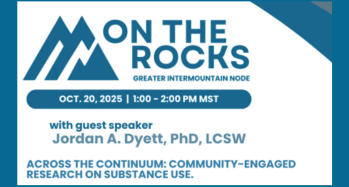
Greater Intermountain Node (GIN) On the Rocks Webinar Series: Community-Engaged Research (Oct. 20, 2025, 1pm MST)
Join the CTN Greater Intermountain Node on October 20, 2025 (1-2pm MST) for the next installment of their GIN On the Rocks webinar series: Across the Continuum: Community-Engaged Research on Substance Use Presenter: Jordan A. Dyett, PhD, LCSWAssistant ProfessorDivision of Social Work, University of Wyoming In this session, Jordan A. Dyett, PhD, LCSW, of the University of Wyoming, will outline the community-engaged research continuum and key methodological considerations for partnering with communities. She will share examples from her research to illustrate different points along the continuum and show how this approach complements other methods in addressing the drug crisis. In-person: Colorow Building, Seminar Room 204, University of Utah (383 Colorow Way, Salt Lake City, UT)On Zoom: Meeting ID: 810 3810 4237; passcode: ginotr Posted on October 13, 2025
-
NE Node Science Series: Meeting Teens Where They Are: Harnessing the Power of Digital Health Games to Impact Adolescent Behavioral Health (Oct. 16, 9am PT)
In this webinar from the Northeast Node’s Science Series, Dr. Lynn E. Fiellin will discuss the: Role of Digital Health Games, like those developed by the play2PREVENT Lab, which can serve as effective tools for addressing adolescent mental health and substance use challenges by engaging youth where they are and providing scalable, cost-effective interventions. Impact of User-Centric Game Development and examine the importance of involving adolescents in the design and development process of health-focused video games, ensuring relevance and effectiveness through iterative feedback and collaboration. Efficacy of Evidence-Based Interventions reviewing the methodologies and outcomes of randomized controlled trials conducted to assess the impact of digital health games on health behaviors, such as opioid misuse prevention and mental health promotion among high-risk adolescents. Register for this session here!
-
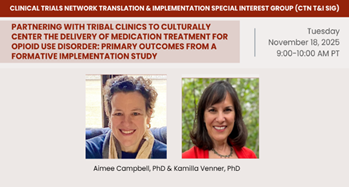
CTN T&I SIG: Partnering with Tribal Clinics to Culturally Center the Delivery of Medication Treatment for Opioid Use Disorder (Nov. 18, 9am PT)
Join the CTN Translation & Implementation (T&I) SIG on November 18, 2025 (9-10am PT) for their next session: Partnering with Tribal Clinics to Culturally Center the Delivery of Medication Treatment for Opioid Use Disorder: Primary Outcomes from a Formative Implementation Study, presented by Aimee Campbell, PhD and Kamilla Venner, PhD. American Indian/Alaska Native (AI/AN) people exhibit many cultural strengths and resiliencies, yet rates of opioid overdose mortality continue to be the highest of all racial/ethnic groups in the U.S. This presentation will describe the development and testing of an implementation intervention, in partnership with four AI/AN-serving clinics, to culturally center the delivery of MOUD in order to improve implementation outcomes. See flyer for more details. Contact Elena Rosenberg-Carlson at rosenbee@stanford.edu for the meeting link or to join the CTN T&I SIG listserv.