-
News from the Southern Consortium Node
The Southern Consortium Node held its quarterly Policy Advisory Committee meeting on September 16, 2024 at the Tri-County Commission on Alcohol and Drug Abuse in Orangeburg, SC. One of the committee’s members, Mike Dennis, leads Tri-County and provided the committee with a tour of its newly-constructed adolescent treatment facility. The committee then convened for an in-depth discussion of challenges and opportunities for research and practice enhancement in the areas of substance use disorder prevention, treatment, and recovery, with a special focus on the Southeastern region of the United States. Posted November 18, 2024.
-
News from the Health Systems Node
Kelly Young-Wolff, PhD, MPH, Health System Node faculty, and Research Scientist at the Kaiser Permanente Northern California Division of Research, co-authored a new report examining the problem of increasing potency of cannabis and cannabis products as a member of an independent scientific committee convened by the California Department of Public Health. The report, Report and Recommendations of the High Potency Cannabis Think Tank to the State of California, shares health and equity-based policy recommendations to increase public awareness, promote safer use and reduce exposure to the highest risk groups. Download the full report | Download highlights (including Top Ten Recommended Policies by Likely Greatest Impact on Adverse Outcomes) Gwen Lapham, PhD, MPH, MSW, Health System Node faculty, and Assistant Investigator at Kaiser Permanente Washington Health Research Institute, is first author on a new publication in Journal of General Internal Medicine evaluating the use of a one question screening tool in primary care settings (CTN-0077). Among patients who reported past-year cannabis use as part of routine screening, the prevalence of cannabis use disorder (CUD) and other cannabis exposure measures increased with greater frequency of cannabis use, underscoring the utility of brief cannabis screens for identifying patients at risk for CUD. Lapham GT, Bobb JF, Luce C, Oliver MM, Hamilton LK, Hyun N, Hallgren KA, Matson TE. Prevalence of Cannabis Use Disorder Among Primary Care Patients with Varying Frequency of Past-Year Cannabis Use. J Gen Intern Med 2024 (in press). Emily Williams, PhD, MPH, HSN Node faculty, Professor, University of Washington,…
-
2025 NIDA Summer Research Internship Program: Apply by Jan 6, 2025
NIDA’s Office of Research Training, Diversity, and Disparities offers paid summer research internships to expose undergraduate students to the field of substance use and addiction research. Selected students work with distinguished scientists at research institutions across the United States for eight weeks during the summer. Internships involve hands-on experiences that may include laboratory experiments, data collection, data analysis, formal courses, participation in lab meetings, patient interviews, manuscript preparation, library research, literature reviews, and more. This effort is intended to provide opportunities for talented students, particularly those who have fewer opportunities for research experience available to them. Eligibility Must be an undergraduate student in good standing at the time of the application. Support Provided NIDA partners with Rose Li & Associates, Inc. (RLA) to manage intern payments, including: NIDA does not cover costs for conference attendance, meals, utilities, or household furnishings. How to Apply Applicants should complete all sections of the application, including the selection of three preferred internship sites from the program guide, and explain how each aligns with their interests. Application materials must include: For more information about the NIDA Summer Research Internship Program, contact: Julie HuffmanProgram Coordinator, NSRIPOffice: 301-443-9798NSRIP@NIH.GOV For more information, check out the NIDA Summer Internship Program Guide.
-
News from the Appalachian Node
David Scott, Appalachian Node CTN-0100 Project Coordinator and CIRCL member, moderated a plenary session, Spectrums in Recovery and Treatment, at the AMERSA annual meeting in Chicago, November 2024. The session, attended by the 800 conference participants, featured a panel of three individuals with lived experience who are national leaders in advocating and supporting individuals who use drugs. Laura Lander, MSW, LICSW gave an interview to Lori Kersey of West Virginia Watch about SB 2028 on October 22, 2024, a bill written and signed into Law by the governor on October 18th to support NIDA CTN research studies being able to dispense study medication. The bill was sponsored by Sen. Takubo. Lander said Senate Bill 2028 will allow researchers at the Wetzel County site to dispense larger amounts of buprenorphine directly to patients involved with the study instead of through a pharmacy. Lawmakers limited the legislation to allow the study at New Beginnings along with a separate study at PROACT, a Huntington clinic that’s part of Marshall Health. Read the West Virginia Watch piece here!
-
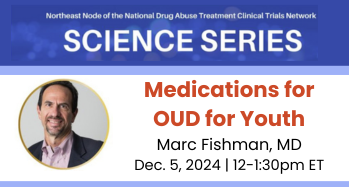
Northeast Node Webinar: Medications for OUD for Youth (Dec. 5, 12pm ET)
In 2021, one in every 100 kids aged 12-17 had an opioid use disorder (OUD). Medication treatment for OUD (MOUD) is effective, but only 3-4% of youth who need it receive treatment. This session will outline features of youth treatment for OUD, evidence for treating youth with medications, youth MOUD uptake and retention, the role of families in care, and opportunities for interdisciplinary care teams in outpatient settings. In this extended session, Dr. Marc Fishman (Mountain Manor & Johns Hopkins) will also facilitate interactive case reviews with attendees. If you have a case you would like to present, please let Bethany McLeman know: bethany.m.mcleman@dartmouth.edu Register for the webinar here!
-
NIH Minority Health and Health Disparities Strategic Plan Seeking Input
Charged with leading scientific research to improve minority health and reduce health disparities, NIMHD is launching the development of the 2026 – 2030 NIH Minority Health and Health Disparities Strategic Plan. The NIH wants to hear your experiences, insights and ideas to help shape the future of minority health and health disparities research efforts. Share your input on the new strategic plan at upcoming community virtual townhalls and respond to the newly released Request for Information (NOT-MD-25-002; deadline December 31, 2024). These important opportunities are open to all. Join NIH in working to improve minority health, reduce health disparities, promote health equity and create a more inclusive, healthier future for all. Virtual townhalls: 1:00 – 3:00 p.m. ETFriday, November 15, 2024Wednesday, December 4, 2024Register here Request for Information (NOT-MD-25-002): Submission due December 31, 2024
-
News from the Ohio Valley Node
CTN-0150 (TOME) study is completed! The CTN-OVN has successfully completed the CTN-0150 (TOME; LI – Winhusen) study activities and is now heading into data analysis. This study was part of the supplemental IMPROVE funds from NIDA and the NICHD awarded to the OVN to utilize the CTN-0080 study as a platform to collect additional data regarding Opioid Use Disorder in pregnant/postpartum populations. TOME included two objectives: 1) to evaluate the ability of the Personally-Tailored Opioid-overdose and Medication for opioid use disorder (MOUD) Education (TOME) intervention to increase MOUD and opioid-overdose knowledge in pregnant and postpartum (PP) persons (Primary), and 2) to evaluate the ability of TOME to decrease MOUD-related internalized stigma and expected difficulty in avoiding drug use (Secondary). Six of the 13 MOMs sites participated and enrolled 131 participants (goal: 120). Congratulations and thank you to the TOME sites! Two new studies in development! The CTN-OVN has recently been approved to move forward with two new studies, both of which will be funded by the NIH HEAL Initiative: CTN-0152: Evaluation of Tirzepatide as an Adjunct to Buprenorphine for the treatment of opioid use disorder: A pragmatic, multi-site, double-blind, Randomized, placebo-controlled, trial (TAB; LI – Winhusen) will test tirzepatide, which is a GLP-1 and glucose-dependent insulinotropic polypeptide (GIP) agonist, as an adjunct to buprenorphine for the treatment of opioid use disorder. It is anticipated that 12 sites will recruit approximately 310 participants into this 30-week study. The study is currently in the process of site selection, with a goal…
-
New in the Library (October-November 2024)
Here are the latest items added to the CTN Dissemination Library for October-November 2024 (this post will be updated as new items come in): Machine Learning-Driven Analysis of Individualized Treatment Effects Comparing Buprenorphine and Naltrexone in Opioid Use Disorder Relapse Prevention. Afshar M, et al. Journal of Addiction Medicine 2024;18(5):511-519. (CTN-0051) Variation in Opioid Agonist Dosing in Clinical Trials by Race and Ethnicity. Ross RK, et al. JAMA Network Open 2024;7(10):e2436612. Sublingual Buprenorphine-Naloxone Compared With Injection Naltrexone for Opioid Use Disorder: Potential Utility of Patient Characteristics in Guiding Choice of Treatment. Nunes EV, et al. American Journal of Psychiatry 2021;178(7):660-671. (CTN-0051) Examination of Correlates of OUD Outcomes in Young Adults: Secondary Analysis From the XBOT Trial. Fishman M, et al. American Journal on Addiction 2021;30(5):433-444. (CTN-0051) Nonparametric Causal Mediation Analysis for Stochastic Interventional (In)direct Effects. Hejazi NS, et al. Biostatistics 2023;24(3):686-707. (CTN-0051) Polysubstance Use Before and During Treatment with Medication for Opioid Use Disorder: Prevalence and Association with Treatment Outcomes. Bunting AM, et al. Journal of Substance Abuse Treatment 2022;143:108830. (CTN-0051) Impact of Medication-Based Treatment on Health Care Utilization Among Individuals With Opioid Use Disorder. Gopaldas M, et al. Psychiatric Services 2023;74(12):1227-1233. (CTN-0051) Clinical and Psychosocial Outcomes by Sex Among Individuals Prescribed Buprenorphine-Naloxone (BUP-NX) or Extended-Release Naltrexone (XR-NTX) for Opioid Use Disorder. Paschen-Wolff M, et al. American Journal on Addiction 2023;32(6):584-592. (CTN-0051) Secondary Analysis of Agreement Between Negative Timeline Follow Back Report and Negative Urine Toxicology in a Large Trial of Individuals with Opioid Use Disorder. Shulman M, et…
-
CTN T&I SIG Webinar: Implementation Outcomes in NIDA Clinical Trials Network Studies (Nov. 19, 9am PT)
Join the Translation and Implementation SIG on November 19th (9am-10am PT) for their next session, titled, “Implementation Outcomes in NIDA Clinical Trials Network Studies: A Systematic Review of Studies Conducted Over 25 Years in the CTN.“ This webinar will be presented by Sophia Gonzalez, MPH and Joe Glass, PhD, MSW of the CTN T&I Implementation Outcomes Workgroup and will focus on a study to explore and document the evolution of the inclusion of implementation outcomes across trials conducted within the CTN, characterize outcomes included, identify gaps and potential opportunities to strengthen implementation research within the CTN, and inform the broader field of SUD treatment. Contact Helene Chokron Garneau at hchokgar@stanford.edu if you would like to attend!
-
New in the Library (September-October 2024)
Here are the latest items added to the CTN Dissemination Library for September– October 2024 (this post will be updated as new items come in): Falling Through the Cracks: The Struggle of Adolescents with Opioid Use Disorder in the Face of Limited Treatment Options. Kaliamurty S. Youth Special Interest Group (SIG) webinar, September 2024. Changes in Prenatal Cannabis Use Among Pregnant Individuals From 2012 to 2022. Young-Wolff KC, et al. Obstetrics & Gynecology 2024;144(4):e101-e104. (CTN-0104) Effectiveness of a Vaping Cessation Text Message Program Among a Diverse and High-Risk Sample of Adolescent E-Cigarette Users (webinar recording). Graham AL. Youth Special Interest Group (SIG) webinar, September 2024. Peer Intervention to Link Overdose Survivors to Treatment (PILOT): Protocol for a Multisite, Randomized Controlled Trial Conducted Within the National Institute on Drug Abuse Clinical Trials Network. Papa C, et al. JMIR Research Protocols 2024;13:e60277. (CTN-0107)