-
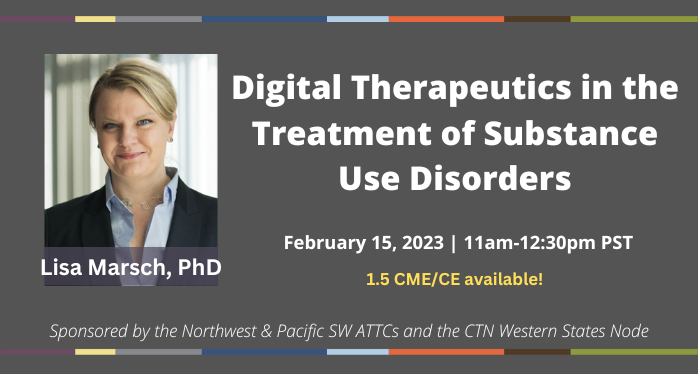
CTN & ATTC Webinar: Digital Therapeutics in the Treatment of SUD (Feb 15, 11am PT
February 15, 2023 | 11am-12:30pm PT | Register here! Digital therapeutics–software used to prevent, treat, or manage a medical disorder or disease–are redefining the future of healthcare. Digital therapeutics package an entire model of care that can be delivered with fidelity and in accordance with state-of-the-science best practices into a unified, seamless digital delivery system. Digital therapeutics have been particularly transformative in the field of substance use, mental health, and other behavioral health conditions and can markedly improve access to care, quality of care, and treatment outcomes, while reducing costs, for a wide array of audiences in diverse settings. In this presentation, Dr. Lisa A. Marsch (Dartmouth Center for Technology and Behavioral Health) will review the state of the science of digital therapeutics for behavioral health and timely opportunities to scale up access to these digital health tools via multiple paths to deployment around the world. Learning objectives 1.5 CME or CE credits available. See flyer for details on accreditation. Sponsored by the Northwest and Pacific Southwest ATTCs and the Western States Node of the NIDA CTN.
-
News from the Northeast Node: Science Series Update
January 8, 2023 Northeast Node Science Series kicks off its ’22-23 Academic Year with an in-depth review of cannabis as a potential pharmacological adjunct to MOUD In November 2022, the Northeast Node welcomed Dr. Ziva Cooper of the UCLA Center for Cannabis & Cannabinoids to kick off the Node’s ’22-23 Academic Year Science Series. Dr. Cooper’s presentation, “Cannabis and Opioids: Promising pharmacology to address the opioid epidemic?” gave a brief overview of cannabis and the pharmacology of phytocannabinoids. Preclinical studies and randomized controlled trials have examined the potential for cannabinoids to modulate opioid effects and withdrawal symptoms, opioid abuse liability, and opioid analgesia. Dr. Cooper reviewed basic cannabinoid pharmacology and the state of evidence supporting the utility of cannabinoids for opioid use disorder and as an adjunct to opioids for pain management. The recorded presentation is available to all on the Northeast Node’s website. On Thursday, February 9, 2023 (12-1pm ET), the Science Series will welcome Craig R. Rush, PhD, from the University of Kentucky as he presents “Treating Stimulant Use Disorders in the Context of the Opioid Crisis: A Review.” Please email Northeast.Node.CTN@Dartmouth.edu to join the Science Series or Northeast Node mailing lists to stay in the know about the Science Series.
-
New Articles from CTN-0049 (Project HOPE) and CTN-0073 (PROUD)
January 8, 2023 Added to the CTN Dissemination Library recently: Differential effects of patient navigation across latent profiles of barriers to care among people living with HIV and comorbid conditions.Traynor SM, et al. Journal of Clinical Medicine 2023;12:114. This paper reports on a study analyzing data from CTN-0049 (Project HOPE) to see if patient navigation interventions (with and without contingency management) are effective at increasing engagement in HIV care and viral suppression for people living with HIV. Find it in the CTN Dissemination Library. Baseline representativeness of patients in clinics enrolled in the PRimary care Opioid Use Disorders treatment (PROUD) trial: Comparison of trial and non-trial clinics in the same health systems.Wartko PD, et al. BMC Health Services Research 2022;2:1593. In this paper, researchers report on an analysis comparing patients in participating and non-participating clinics from the same health systems at baseline in the PROUD trial (CTN-0074) to see if there are any differences between patients in clinics willing and able to participate in trials and those that aren’t.
-
Protocol News: CTN-0100
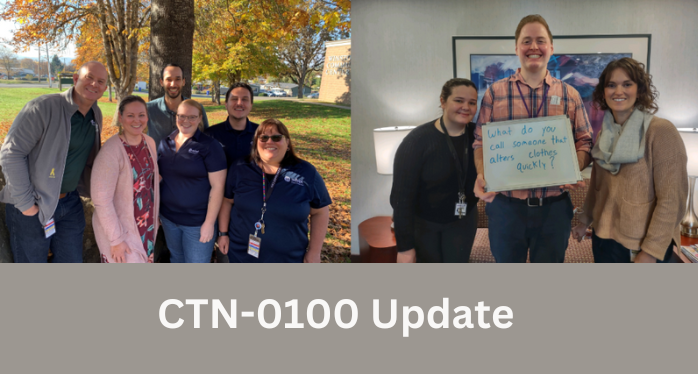
December 8, 2022 In November, the CTN-0100 Project Team launched a month-long BINGO challenge aimed at boosting recruitment across the 18 study sites. BINGO squares included hitting (or exceeding!) randomization targets for the month, reuniting with a missing participant, and completing internal QA. The Adapt site from the Western States Node and the SSTAR site from the New England Consortium Node were the first sites to “BINGO”, just 16 days into the challenge (see photos of the winning team below)! 7 additional sites achieved “BINGO” by the end of the month. We thank all of the CTN-0100 sites for their continued diligence on this project. Check out the BINGO sheet here!
-
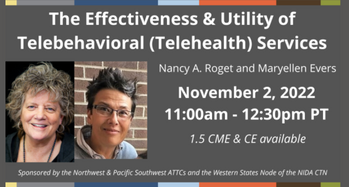
Webinar: The Effectiveness & Utility of Telebehavioral (Telehealth) Services, Nov. 2, 11am PT
The goal of the National Institute of Drug Abuse (NIDA) Clinical Trials Network/Addiction Technology Transfer Center (ATTC) webinar series is to help scholars and clinicians in the addiction field stay abreast of cutting-edge science. This series is sponsored by the Western States Node of the CTN and the Pacific Northwest and Pacific Southwest ATTCs. The uptake in the use of telebehavioral services since the start of the Public Health Emergency (PHE) has been swift and is significantly transforming how behavioral health services are delivered. This is encouraging, as the research base for assessing and treating mental health conditions virtually is extensive and over 60 years old. However, for substance use disorders (SUDs), the research is less extensive and more recent. Mental health and SUD treatment services provided virtually are effective and serve as viable alternatives to in-person service delivery. Patients confirm high levels of satisfaction with telebehavioral health, while practitioners report more reluctance. Nonetheless, training has been shown to build practitioners’ skills, confidence, and competency. Using technology to facilitate clinical or recovery support sessions requires clinicians and peer support specialists to simulate real-time experiences (Hilty, 2002) that promote a therapeutic alliance (treatment) or connection (peer support). However, virtual service delivery requires some careful modification of the clinicians’ or peer support specialists’ skills to ensure engagement occurs and positive working relationships are developed. This webinar, presented by Nancy A. Roget, MS, MFT, LADC and Maryellen Evers, LCSW, CAADAC, CMFSW, will include a brief review of: telebehavioral health research and its efficacy, strategies…
-
News from the Florida Node Alliance
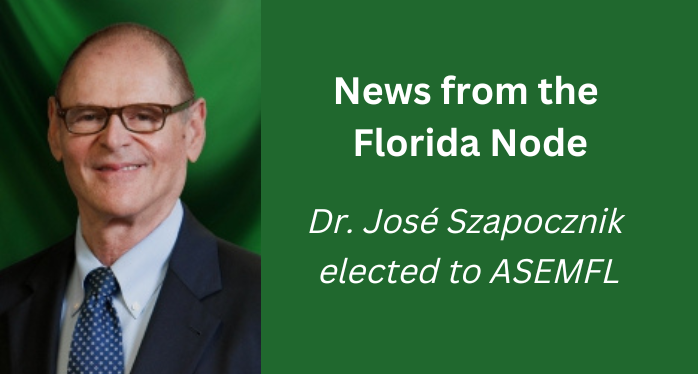
Dr. José Szapocznik, Multiple PI of CTN’s Florida Node Alliance and Professor and Chair Emeritus at the Department of Public Health Sciences, of the University of Miami Miller School of Medicine, was elected to the Academy of Science, Engineering and Medicine of Florida (ASEMFL), an evidence-based scientific advisory body focused on providing expert advice to state government and other organizations on current and future challenges facing the world and Florida. Recognizing four and a half decades of important contributions to developing and testing interventions in the areas of mental health and drug abuse, ASEMFL elected Dr. Szapocznik for his “exemplary contributions to prevention science and globally impactful substance use prevention for youth and families.” Dr. Szapocznik’s formal induction will take place during the ASEMFL’s 2022 annual meeting in early November. Please join us in congratulating Dr. Szapocznik for this prestigious accomplishment!
-
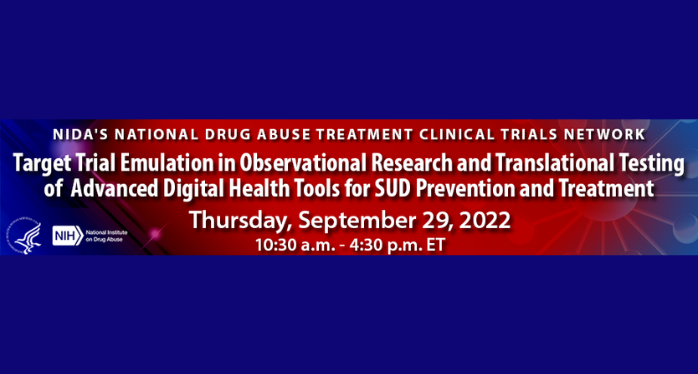
Webinar: Target Trial Emulation in Observational Research and Translational Testing of Advanced Digital Health Tools for SUD Prevention and Treatment (Sept 29, 2022)
The National Institute on Drug Abuse (NIDA) Center for the Clinical Trials Network (CCTN) is hosting a virtual workshop titled “Target Trial Emulation in Observational Research and Translational Testing of Advanced Digital Health Tools for SUD Prevention and Treatment.” This workshop is scheduled for Thursday, September 29, 2022, from 10:30 a.m.– 4:30 p.m. ET. This workshop aims to introduce these trending approaches; assess their strengths, limitations, and potential; discuss feasible research questions; identify study priorities, and explore actionable strategies to address barriers and challenges for advancing substance use disorder (SUD) research. The workshop consists of three subthemes with the following speakers. Learning SUD Evidence From Nationwide Data Sources Christopher Jones, Pharm.D., Dr.PH., M.P.H. Centers for Disease Control and Prevention Beth Han, M.D., Ph.D., M.P.H. National Institute on Drug Abuse, National Institutes of Health Julie Donohue, Ph.D. University of Pittsburgh Target Trial Emulation Using Real-World Healthcare Data Sara Lodi, Ph.D. Boston University Rolf Groenwold, Ph.D. Leiden University, Netherlands Joshua Wallach, Ph.D. M.S. Yale University Marc LaRochelle, M.D., M.P.H. Boston University Translational Testing of Clinical- and Community-Based Digital Health Systems Brandon Marshall, Ph.D. Brown University Rebecca Rossom, M.D., M.S. HealthPartners Jenny Lo-Ciganic, Ph.D., M.S.Pharm. University of Florida Walid Gellad, M.D., M.P.H. University of Pittsburgh Majid Afshar, M.D., MSCR University of Wisconsin-Madison Meeting Chair: Lisa Marsch, Ph.D. Dartmouth College