-
News from the Pacific Northwest Node: Updates from CTN-0082 and CTN-0102-XR
CTN-0082 update CTN-0082 had another paper published: Predicting Willingness to Use MOUD: An Application of the Theory of Reasoned Action and Theory of Planned-Behavior. Lancaster C, et al. Journal of Drug Issues 2025 (in press). The paper reports on a study that used the Theory of Reasoned Action (TRA) and Theory of Planned Behavior (TPB) to assess willingness to use 3 medications (methadone, buprenorphine, naltrexone) for opioid use disorder (MOUD) among people who use opioids (PWUOs). Findings partially supported the TRA but not TPB, with positive attitudes associated with greater willingness to use all three types of MOUD, pointing to the value of syringe services programs as a low threshold hub for treatment engagement. CTN-0102-XR update Providence Northeast Washington Medical Group – Colville finished all participant involvement in CTN-102-XR ending with an unheard of 100% retention rate! We want to send a huge congratulations to the team in Colville for their excellent work engaging participants and providing top notch care!
-
News from the Health Systems Node
Join the Health Systems Node on December 4 for this virtual seminar: The Right Support at the Right Time: Just-in-Time Adaptive Interventions (JITAIs) for Substance Use with Dr. Kristina Phillips December 4, 2025 10 am – 11 am PT Just-in-time adaptive interventions (JITAIs) represent a cutting-edge approach to promoting healthier behaviors, including the reduction of substance use. By delivering personalized, real-time support precisely when individuals need it most, JITAIs have the potential to transform the landscape of mobile health (mHealth). In this seminar, Dr. Kristina Phillips will introduce the conceptual and methodological foundations of JITAIs, including a focus on intensive longitudinal data collection. Key challenges related to privacy and sustained engagement will be addressed, alongside a review of experimental designs commonly employed to optimize JITAIs. The talk will conclude with an example from an ongoing clinical trial evaluating the preliminary efficacy of a novel JITAI targeting young adults who co-use cannabis and alcohol, illustrating the practical application of these methods. Website/link to join:Join the meeting nowMeeting ID: 250 658 877 216 6Passcode: B8jq2m9A Posted on November 19, 2025.
-
News from the Health System Node: INEBRIA presentation, Prenatal cannabis use, Upcoming webinar
Stacy Sterling, DrPH, MSW, MPH, and Derek Satre PhD, Health System Node faculty, hosted the International Network on Brief Intervention for Alcohol or Other Drugs (INEBRIA) conference in San Francisco, CA on September 24-26, 2025. INEBRIA is dedicated to evaluating the effectiveness of brief interventions in different settings with different types of patients. A great turn out, with more than 130 researchers from around the world in attendance. Research by Kelly Young-Wolff, PhD, MPH, Health System Node faculty, and Research Scientist at the Kaiser Permanente Northern California Division of Research, was highlighted in the new ACOG guidelines on prenatal cannabis use. Upcoming online seminar The new Health Systems Node Seminar Series presents Lessons Learned About Treating Co-occurring Conditions Among Adults Receiving Substance Use Disorder Treatment with Dr. Mark Ilgen, PhD. Join us for online seminar on November 6, 2025 @ 10 am PT. No registration required. Contact Morgan Ford for more information: morgan.ford@kp.org. Website/link to join:Join the Microsoft Teams Meeting hereMeeting ID: 250 658 877 216 6Passcode: B8jq2m9A Description: Co-occurring mental health and physical problems are common among patients receiving treatment for substance use disorders. When present, these issues typically predict poorer functional and substance-related outcomes following treatment. This suggests that addressing co-occurring problems during an episode of substance use disorder treatment could significantly improve a wide range of outcomes. However, prior studies have yielded somewhat inconsistent results regarding the additional and/or synergistic benefits of treating co-occurring mental health and physical problems beyond the standard effects of substance use…
-
News from the Greater Southern California Node: New Publication
The Greater Southern California Node has a new publication out about CTN-0143 (Social Determinants of Health: Needs and Consequences Associated with Substance Use Disorders): A scoping review of interventions addressing social determinants of health and their influence on opioid use disorder outcomes. Cousins SJ, et al. Drug and Alcohol Dependence 2025;276:112858. Over the past decade, opioid overdose deaths have risen sharply. The Social Determinants of Health (SDOH) framework can guide interventions to improve opioid use disorder (OUD) outcomes. Understanding which SDOH-focused interventions work — and how they affect OUD — can help meet the needs of people at risk or living with OUD. This scoping review looked at SDOH interventions and their impacts on OUD outcomes across five domains. Most focused on the healthcare system (37%), improving provider training, access, and care quality. Others addressed community and social context (30%) through support programs and coalitions; economic stability (16%) via employment and financial incentives; neighborhood environment (9%) through Housing-First models; and education (2%) with early prevention programs. These efforts generally reduced opioid use, overdoses, and stigma. However, inconsistent SDOH definitions and limited rigorous evaluation hinder clear conclusions. Strengthening study design and measurement is crucial to advance effective SDOH-based OUD interventions. Read the full paper here! (free full text) Posted on October 14, 2025
-
News from the Southern Consortium Node: Dr. Brady, one of Charleston, SC’s Most Influential People!
Dr. Kathleen Brady, principal investigator of the CTN Southern Consortium Node, was recently named one of the top most influential people in Charleston, South Carolina, by Charleston Magazine! From the article: The Researcher: Kathleen Brady, MD Medical research is that nerdy enterprise most of us don’t pay attention to, until we need it. Given that nearly 17% of Americans over age 12 faced a substance [use] disorder in the last year, chances are you’ll need it. Enter Dr. Kathleen Brady, vice president for research and distinguished professor and MUSC [Medical University of South Carolina], where for more than three decades, she’s led the charge for evidence-based treatments, studying how anxiety, affective disorders, and PTSD affect addiction, particularly in women. Brady has been the top NIH-funded investigator at MUSC and in the top five percent nationally for over a decade, receiving the SC Governor’s Award for Excellence in Science for her contributions, including ensuring clinical trial discoveries reach frontline providers. “I’m committed to science and research, but my interest lies in how these improve the lives of patients,” the Betty Ford Award recipient said. That bridge proved vital when the opioid crisis hit South Carolina. Brady’s work has expanded treatment capacity, including telehealth, screening, and ER intervention for opioid addiction throughout the state, saving countless lives. Congratulations, Dr. Brady! Read the piece from Charleston Magazine here (Dr. Brady is #43 in the list) Posted on October 13, 2025
-
News from the Pacific Northwest Node: October Retreat and Art Break!
The CTN Pacific Northwest Node team took some time out on October 2nd and 3rd to do some goal-setting for the coming year. As a reward for all their hard work, they participated in a Paint and Sip at Canvas in Redmond, funded by a University of Washington School of Medicine Well Being grant! Check out the incredible artwork of this multi-talented Node team! Pictured: (Back, left to right) Kai Orozco, Brenda Stuvek, Michelle Ingalsbe, Mary Hatch(Front, left to right) Tanja Laschober, Sharon Garrett Posted on October 13, 2025
-
Greater Intermountain Node (GIN) On the Rocks Webinar Series: Community-Engaged Research (Oct. 20, 2025, 1pm MST)
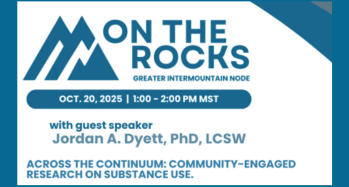
Join the CTN Greater Intermountain Node on October 20, 2025 (1-2pm MST) for the next installment of their GIN On the Rocks webinar series: Across the Continuum: Community-Engaged Research on Substance Use Presenter: Jordan A. Dyett, PhD, LCSWAssistant ProfessorDivision of Social Work, University of Wyoming In this session, Jordan A. Dyett, PhD, LCSW, of the University of Wyoming, will outline the community-engaged research continuum and key methodological considerations for partnering with communities. She will share examples from her research to illustrate different points along the continuum and show how this approach complements other methods in addressing the drug crisis. In-person: Colorow Building, Seminar Room 204, University of Utah (383 Colorow Way, Salt Lake City, UT)On Zoom: Meeting ID: 810 3810 4237; passcode: ginotr Posted on October 13, 2025
-
News from the Greater Intermountain Node: Upcoming Cannabis Seminar and CTN-0151 Updates
Greater Intermountain Node Seminar Series “On the Rocks” On the Rocks (OTR) is the Greater Intermountain Node’s (GIN) monthly Research Discussion Series, spotlighting standout addiction-related research from across the Greater Intermountain community. Designed for dynamic exchange, OTR fosters collaboration and fresh thinking through interactive conversations between presenters and attendees. The series name nods to the stunning Rocky Mountain backdrop and the iconic Utah trails just steps from our offices. Join us for the next OTR on Wednesday, October 1, 2025, from 12–1 PM MST, featuring “Cannabis: Balancing Risk and Therapeutic Potential” with Marcel O. Bonn-Miller, PhD. Dr. Bonn-Miller will share insights from three key research areas: Cannabis Use Disorder, the therapeutic promise of cannabinoids, and regulatory science. He’ll present findings on cannabis use among veterans with PTSD, explore cannabinoid-based treatments for sleep, anxiety, and substance use disorders, and discuss CBD safety standards and regulatory frameworks. Dr. Bonn-Miller holds a BA and PhD in clinical psychology from the University of Vermont and completed a postdoctoral fellowship at Stanford. He launched his research career at the VA and University of Pennsylvania, later leading cannabis research in both academic and industry settings. He now serves as Chief Scientific Officer at Charlotte’s Web and has authored over 175 peer-reviewed publications. Visit the OTR website to learn how to join. Free CME/CE credit available for live attendees. CTN-0151 Update The Greater Intermountain Node is proud to collaborate with the University of Tennessee Health Science Center, Dr. Kenneth Hohmeier, and Dr. Rachel Barenie on CTN-0151:…
-
News from the Greater Southern California Node
Publication announcement Zhu, Y., Cousins, S. J., Clingan, S. E., Mooney, L. J., Saxon, A. J., Evans, E. A., & Hser, Y. I. (2024). Racial and Ethnic Differences in Long-Term Outcomes among Individuals with Opioid Use Disorder at Opioid Treatment Programs. Journal of Racial and Ethnic Health Disparities 2024 (in press). DOI: 10.1007/s40615-024-02273-w. Mini documentary/video clip The Recovery Incentives Program: California’s Contingency Management Benefit The UCLA ISAP Implementation Team, DHCS, Q2i, and sites participating in California’s Contingency Management Benefit Program collaborated to create a video documentary about the Recovery Incentives Program. The 5-minute video features several personal statements about the impact of the program, from both providers and participating members, and highlights the importance and meaning of the Recovery Incentives Program. #CMworks, #recoveryincentives, #flipthescript, #UCLAISAP. Posted on September 15, 2025.
-
Virtual Training: Contingency Management: Implementation of a Highly Effective Intervention for the Treatment of Stimulant Use Disorder (September 12, 2025, 10am-12pm PT)
The UCLA Neuropsychiatric Institute and Hospital is celebrating its 50th anniversary. Please join the Greater Southern California Node for this free live virtual training on Friday September 12, 2025, from 10am to 12pm PST: Contingency Management: Implementation of Highly Effective Intervention for the Treatment of Stimulant Use Disorder. Larissa Mooney, MD, Thomas E. Freese, PhD, and Richard A. Rawson, PhD, from UCLA’s Integrated Substance Use and Addiction Programs, Division of Addiction Psychiatry will be delivering the training. Recent evidence indicates that methamphetamine and cocaine play a substantial and increasing role in the illicit drug crisis in the US—the 4th wave of the overdose crisis. The behavioral treatment known as contingency management (CM) has more than three decades of robust research supporting its efficacy for individuals with stimulant use disorder (StimUD). Despite overwhelming evidence supporting CM, it has not been widely used in routine treatment outside the VA healthcare system. This situation is changing as states are arranging insurance reimbursement for CM and developing CM programming for individuals with StimUD. This presentation, provided by a team from UCLA Integrated Substance Use and Addiction Programs will begin with a brief overview of how cocaine and methamphetamine use are contributing to the current drug poisoning crisis. Presenters will review CM protocol elements, evidence for CM, current obstacles to widespread implementation of CM, and strategies for addressing barriers. Presenters will also discuss the implementation strategies and preliminary results from the largest implementation of CM in publicly-funded treatment centers to date: The California Recovery Incentives Program.…