-
News from the Health Systems Node
After 10 years of leadership as Project Director for the Health System Node, Andrea Altschuler, PhD is passing the torch to Monique Buffler, MPH. Fortunately, Andrea will continue to be involved in HSN with community engagement efforts. In her new role, Monique will assist MPIs with coordination and management of node activities. Kelly Young-Wolff, PhD, MPH, site PI with the Health System Node, and Research Scientist at the Kaiser Permanente Northern California Division of Research, was part of the National Academies of Science, Engineering and Medicine (NASEM) consensus panel who wrote the new report: Cannabis: Policy Impacts Public Health and Health Equity (2024). This report follows on the 2017 landmark NASEM report on the health effects of cannabis. This report fills an important gap in outlining key steps for reducing the harm of cannabis and hemp legalization. It outlines clear and cogent recommendations for improving the public health and equity impact of current policy and calls on CDC and the National Governors Association to further detail best practices and model laws. Download the report and additional resources: Publication Announcements Young-Wolff KC, Chi FW, Campbell CI, Does MB, Brown QL, Alexeeff SE, Ansley D, Wang X, Lapham GT. Association of psychiatric and substance use disorders with cannabis use and cannabis use disorder during early pregnancy in northern California. Addiction. 2024 Jul 31. doi: 10.1111/add.16622. Epub ahead of print. PMID: 39082097. Young-Wolff KC, Chi FW, Lapham GT, Alexeeff SE, Does MB, Ansley D, Campbell CI. Changes in Prenatal Cannabis Use Among…
-
Submit CPDD Paper/Poster Abstracts to CTN Publications Committee by November 29, 2024
CTN members: The receipt deadline for paper and poster abstracts for the June 2025 CPDD annual meeting is December 27, 2024. The Publication Committee would like to remind authors that presentations and poster abstracts should be submitted to the Publications Committee for prior review and approval at least a month in advance (November 29, 2024) of submission receipt deadline for CPDD. Due to holiday schedules, the PC cannot guarantee that we will be able to review and provide comments if these abstracts are not received by December 11th. Please be cognizant of holiday schedules of the PC and its reviewers and provide these CPDD abstracts for review as early as possible. Submit your abstracts to Jack Blaine (jblaine@nida.nih.gov) and Susan Sonne (sonnesc@musc.edu).
-
News from the Big South/West Node
The Big South/West Node is pleased to announce that recruitment for CTN-0132 KMD has officially commenced. This randomized, double-blind, active placebo trial aims to investigate the use of IV ketamine versus midazolam in the treatment of methamphetamine use disorder (MUD). During the 12-week study, participants will receive cognitive behavior therapy (CBT). Currently, two sites are active, and we expect to endorse two additional sites by early November.
-
NIDA HIV Seminar Series: Let’s talk PrEP! Oct. 23, 1pm ET (virtual)
Questions about HIV PrEP and how it relates to people with substance use disorders? The NIDA HIV Research Program has invited some HIV clinical research experts and people living with HIV and substance use disorders to join us in our next virtual Seminar, “Let’s Talk PrEP”, October 23rd, 1-2:30 pm. The seminar includes Drs. Rupa Patel from Whitman-Walker Health and the CDC; Dr. Jaimie Meyer from Yale, and Dr. Hansel Tookes from the University of Miami. Register for the webinar here!
-
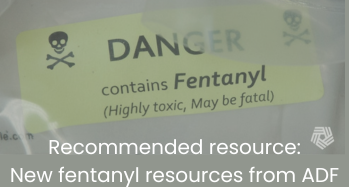
Recommended Resource: Facts About Fentanyl (Addiction Policy Forum)
As fentanyl continues to impact communities at an unprecedented rate, understanding its potency and dangers is critical to reducing harm. By raising awareness and promoting life-saving measures like naloxone, we can work toward preventing overdoses and saving lives. This new video explainer from the Addiction Policy Forum highlights the increase of synthetic opioids like fentanyl, overdose risks, the increase in counterfeit pills containing fentanyl nationwide, and the importance of naloxone access and overdose prevention education. The video is available in English as well as in multiple additional languages.
-
News: U.S. Overdose Deaths Plummet, Saving Thousands of Lives (NPR)
NPR Exclusive: U.S. Overdose Deaths Plummet, Saving Thousands Of Lives. According to NPR (9/18, Mann, 3.69M), state level public health data, “for the first time in decades,” may point to “a sudden and hopeful drop in drug overdose deaths across the US.” University of North Carolina researcher Dr. Nabarun Dasgupta posted data he said show that “in the states that have the most rapid data collection systems, we’re seeing declines of twenty percent, thirty percent.” NIDA Director Dr. Nora Volkow called the decline “exciting,” adding, “This looks real. This looks very, very real.” Volkow said, “Expansion of naloxone and medications for opioid use disorder – these strategies worked.” NPR adds that CDC survey data previously showed “an unprecedented decline in drug deaths of roughly 10.6 percent.” For more information, check out the Opioid Data Lab blog post, “Are overdoses down and why?”
-
Recording available! CTN TH&TM SIG: California Contingency Management Project
Did you miss September’s Telehealth & Telemedicine SIG meeting? No worries, the recording from this presentation is now available in the CTN Dissemination Library! Lessons Learned from Implementation of the California Contingency Management Pilot Presenters: Thomas E. Freese, PhD, and Darren Urada, PhD More than half of individuals admitted for specialty substance use disorder treatment in California identify stimulants as their primary or secondary drug, yet many people who use stimulants do not seek treatment. Numerous studies have shown that contingency management (CM) is the most effective treatment for stimulant use disorder. California’s innovative Recovery Incentives Program is a groundbreaking initiative that benefits California and serves as a potential blueprint for other states. In this webinar, Drs. Freese and Urada will delve into the program’s achievements and challenges by providing an overview of the Program, and preliminary quantitative and qualitative evaluation findings. Presenters will talk about the connection to technology and the potential for telehealth implementation in the future. Time will be provided for Q&A and discussion with the audience. Check out the recording here!
-
CTN Primary Care SIG Meeting: OUD Treatment in Primary Care (Sept. 23, 12pm ET)
Join the CTN Primary Care SIG for their next meeting, featuring Linda Zittleman, MSPH, and Don Nease, Jr., MD (both of University of Colorado Anschutz Medical Campus Department of Family Medicine), talking about: The Odyssey of HOMER: lessons from a pragmatic trial on opioid use disorder treatment in primary care.” September 23, 202412-1pm EST Linda Zittleman, MSPHSenior InstructorHigh Plains Research Network DirectorUniversity of Colorado Anschutz Medical Campus Department of Family Medicine Don Nease, Jr. MDDirector of Community Engagement & Health EquityColorado Clinical & Translational Sciences InstituteProfessor and Green-Edelman Chair for Practice-Based ResearchUniversity of Colorado Anschutz Medical Campus Department of Family Medicine Join the webinar here (no registration required; passcode 291918) Interested in presenting at a future Primary Care SIG meeting? Email Joe LeMaster at jlemaster@kumc.edu or Sebastian Tong at setong@uw.edu
-
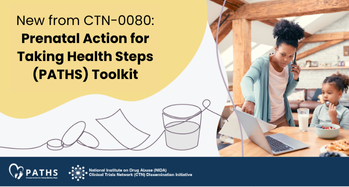
New from CTN-0080: PATHS Toolkit about OUD and Pregnancy Now Available!
The CTN-0080 (MOMs) team has developed a set of dissemination materials around messaging for medications for opioid use disorder (MOUD) in pregnant and postpartum individual, now available on the CTN Dissemination Library website! The Prenatal Action for Taking Health Steps (PATHS) Toolkit includes flyers, info sheets, posters, an education video, and social media images and short videos (“Reels”), all available for download and sharing. There’s also a discussion guide that can be used to direct conversations about MOUD in pregnant/postpartum people either in a group or individual settings, as well as a set of external links and resources that can be helpful to the public. The materials are available in two versions so far — one for the general public and one that has been culturally adapted for American Indian/Alaska Native communities. Spanish translations are also coming soon! Check out the PATHS Toolkit here!
-
Protocol Update: CTN-0100 (RDD)
On August 30, 2024, the CTN-0100 study reached our goal of 950 BUP randomizations in the Retention Phase of the study! This momentous milestone marked the end of recruitment for this phase. The first randomization occurred on June 10, 2021, and as of September 16, 2024 there have 1,139 randomizations overall (951 BUP, 188 Vivitrol). Additionally, five sites achieved their original recruitment goal and three sites reached or surpassed 100 overall randomizations. The Lead Investigators and Project Team express sincere appreciation to the 18 study sites for their unwavering dedication and commitment to this endeavor over the past several years. As we continue to focus on the Discontinuation Phase of the study, with only 70 SL-BUP randomizations remaining, we reflect on our collective knowledge and eagerly anticipate the attainment of yet another study milestone!