-
New in the Library (May – June 2024)
Here are the latest items added to the CTN Dissemination Library for May – June 2024 (this post will be updated as new items come in): “To prescribe or not to prescribe, that is the question”: Perspectives on opioid prescribing for chronic, cancer-related pain from clinicians who treat pain in survivorship. Bulls HW, et al. Cancer. 2024 Apr 3. doi: 10.1002/cncr.35299. PMID: 38567685. CTN-0115 Substance Use Among Black Adolescents – Maximizing Strengths and Overcoming Barriers in Substance Use Prevention. Aneni K. Youth Special Interest Group (SIG) webinar, May 2024. Wiidookaage’win: Beta-test of a Facebook Group Intervention for Native Women to Support Opioid Use Recovery. Roche AI, et al. Journal of Substance Use and Addiction Treatment 2024;163:209396. Discontinuation of Medication Treatment for Opioid Use Disorder After a Successful Course: The Discontinutaion Phase of the CTN-0100 (RDD) Trial. Discontinuation of Medication Treatment for Opioid Use Disorder After a Successful Course: The Discontinutaion Phase of the CTN-0100 (RDD) Trial. Shulman M, et al. Contemporary Clinical Trials 2024;142:107543. CTN-0100 Addiction Medicine Treatment Utilization by Race/Ethnicity Among Adolescents with Substance Use Problem Before Versus During the COVID-19 Pandemic. Palzes VA, et al. Journal of Adolescent Health 2024;74(6):1260-1263. CTN-0117 Overall and Telehealth Addiction Treatment Utilization by Age, Race, Ethnicity, and Socioeconomic Status in California After COVID-19 Policy Changes. Palzes VA, et al. JAMA Health Forum 2023;4(5):e231018. CTN-0117
-
Update on CTN-0082
The CTN-0082 primary outcomes article was recently featured in the NIDA HIV Research Program email newsletter: What predicts willingness to take PrEP among people who use opioids? A cross-sectional survey developed by NIDA’s Clinical Trials Network was given to 308 HIV-negative people who use opioids (PWUO) across eight Southern cities with high HIV incidence. Half had heard of PrEP, but only 4% had ever taken it. Investigators found that willingness to take daily oral PrEP and willingness to take long-acting injectable (LAI) PrEP were moderately high (69.16% and 62.02%, respectively). Educational attainment and having engaged in condomless vaginal sex predicted willingness to take oral PrEP, whereas only educational attainment predicted willingness to take LAI PrEP. The authors suggest these findings could inform more targeted public health messaging. The CTN-0082 outcomes article was authored by Mary A. Hatch of the Pacific Northwest Node and colleagues and is titled “PrEP for people who use opioids: A NIDA Clinical Trials Network survey study in Southern U.S. cities where HIV incidence is high.” Drug Alcohol Depend 2024;257:111133. Find it in the CTN Dissemination Library. Subscribe to the NIDA HIV Research Program newsletter here!
-
Update on CTN-0097: Primary Outcomes Article Published!
The primary outcomes article for CTN-0097, Surmounting Withdrawal to Initiate Fast Treatment with Naltrexone (SWIFT): Improving the Real-World Effectiveness of Injection Naltrexone for Opioid Use Disorder (NIH HEAL Initiative), is now available! Published in JAMA Network Open, the findings from the study suggest that starting people with opioid use disorder (OUD) on extended-release injectable naltrexone (XR-naltrexone) within 5-7 days of seeking treatment is more effective than the standard treatment method of starting within 10-15 days, but requires closer medical supervision. This rapid treatment protocol could make XR-naltrexone more viable as a treatment option for OUD, as the longer waiting period was a significant barrier to implementation of XR-naltrexone for many patients. Read the JAMA Network Open paper | Read the NIDA News Release about it
-
Update on CTN-0100 (RDD)
During March, the CTN-0100 Project Team initiated a month-long BINGO challenge with the goal of boosting QA and participant tracking and retention across the 18 study sites. BINGO tasks encompassed completing all scheduled visits for the week, locating a missing participant, performing internal QA, addressing data queries, and conducting street/community outreach for an MIA participant. The Bellevue site of the New York Node (pictured) achieved “BINGO” first, just 18 days into the challenge! By the end of the month, 9 additional sites also achieved “BINGO.” We express our gratitude to all CTN-0100 sites for their dedication to this project. Download a copy of the BINGO sheet here!
-
Bringing the Latest Evidence-based Substance Use Disorder Treatments into Clinical Practice
The National Institute on Drug Abuse Clinical Trials Network Dissemination Initiative (NIDA CTN DI) promotes the adoption of evidence-based practices and research on substance use disorders into clinical practice. For one recent project, NIDA CTN DI staff partnered with nationally known subject-matter experts in opioid use disorder (OUD) and the Centers for Medicare & Medicaid Services (CMS) to create a four-part podcast series available for continuing medical education (CME) credit. The series, called Buprenorphine Initiation in the Emergency Department: Why, When, and How? takes hospital leaders and emergency department teams through the clinical evidence, the technology, and the community referral networks necessary to implement a successful emergency department-based buprenorphine initiation program. The final podcast of the series offers advice from the CEO of a large medical system who brought buprenorphine treatment to its emergency departments along with other successful OUD treatment initiatives. Bringing these kinds of projects to life follows a consistent process: The NIDA CCTN team works with Bizzell US to identify studies with clinical implications. They also collaborate with health care organizations that synthesize evidence-based research into tools and resources for clinicians, patients, and communities, such as a video and an infographic (also available in Spanish) about the dangers of fentanyl produced with the University of Pennsylvania Center for Addiction Medicine and Policy. Please visit the CTN Dissemination Initiative webpage to learn more about how NIDA CTN DI can help translate study findings into tools and resources that benefit clinicians, patients, and communities. For more information about…
-
New in the Library (Apr – May 2024)
ATTENTION! The new CTN Directory is here! Published in April 2024, it has updated contact information for members of all 16 nodes, the Clinical Coordinating Center, and the Data and Statistics Center. You can find a link to it right on the CTN Dissemination Library’s home page as well as RIGHT HERE. Here are the latest items added to the CTN Dissemination Library for April – May 2024 (this post will be updated as new items come in): Rapid Initiation of Injection Naltrexone for Opioid Use Disorder: A Stepped-Wedge Cluster Randomized Clinical Trial. Shulman M, et al. JAMA Network Open 2024;7(5):e249744. Primary Outcomes Article for CTN-0097 Empirically Contrasting Urine Drug Screening-Based Opioid Use Disorder Treatment Outcome Definitions. Brandt L, et al. Addiction 2024 (in press). CTN-0094 Program Director Reports of COVID-19 Lockdown-Driven Service Changes in Community-Based STI Clinics and Syringe Services Programs in the Southeastern U.S. Hatch MA, et al. AIDS Education and Prevention 2024;36(2):129-140.
-
NIDA Celebrates 50 Years – Comments from NIDA Director Nora Volkow, MD
NIDA Director Nora Volkow, MD, has a new commentary piece out in the American Journal of Psychiatry: Drugs and Addiction Science: NIDA Celebrates 50 Years of Research and Looks to the Future (published online May 6, 2024, doi: 10.1176/appi.ajp.20230880) From the piece: The National Institute on Drug Abuse (NIDA)—first established in 1974 as part of the Alcohol, Drug Abuse, and Mental Health Administration and in 1992 becoming part of the National Institutes of Health (NIH)—is the largest funder of research on drug use and addiction in the world. Over its 50-year history, NIDA’s work has led to tremendous progress in advancing science and improving individual and public health. But the overdose epidemic at hand is a powerful reminder that there is much more to be done. Commemorating NIDA’s 50th anniversary provides an opportunity to acknowledge the significant advances that have been made in addiction science, as well as take stock of the remaining gaps and challenges and affirm our commitment to championing research that can improve the lives of those who are at risk or suffer from a substance use disorder (SUD). Read the complete article here.(Need help getting a copy? Contact the CTN Dissemination Librarian at ctnlib@uw.edu.)
-
News from the Southern Consortium Node
On April 29, 2024, the Southern Consortium Node granted the inaugural Outstanding Public Leadership Award to Sara Goldsby, Director of the South Carolina Department of Alcohol and Other Drug Abuse Services. (Pictured: Drs. Kelly Barth, Kathleen Brady, Connie Guille with Ms. Sara Goldsby.) The award was established to recognize state and local government officials who have made exceptional contributions to the advancement of policy and practice in the field of addiction. Ms. Goldsby has been a tireless advocate for South Carolinians struggling with addiction, leading the state’s response to the opioid crisis and serving as the President of the National Association of State Alcohol and Drug Abuse Directors since 2021. She has also been at the forefront nationally in forging effective partnerships between our state’s government and local universities, most notably through the establishment of the South Carolina Center of Excellence in Addiction in 2022, which is leveraging the strengths of the state’s public universities to advance data-driven, evidence-based solutions to its most pressing needs. During her leadership in the state, Ms. Goldsby has been an important champion for research, engaging in numerous partnerships with the CTN to advance innovative science to treat addiction in South Carolina and beyond. · · · · · · · · · · · · · · · · · · · · · · · The South Carolina Governor’s Opioid and Addiction Summit was held in Columbia, SC on April 29-May 1 and provided an excellent forum for dissemination of Clinical Trials…
-
Artificial Intelligence in Medicine & Imaging (AIMI) Symposium 2024 (May 15, Free, @ Stanford and Online)
Machine learning and artificial intelligence are redefining the boundaries of medicine, unleashing potential like never before to ensure better health for all. Sponsored by the Stanford University Center for Artificial Intelligence in Medicine & Imagining (AIMI), the FREE AIMI Symposium serves as their flagship annual meeting, focusing on the pioneering developments and significant strides in AI that are shaping the future of healthcare. They will highlight cutting-edge research and methods, showcase current and emerging real-world clinical applications, and address critical issues related to fairness and societal impact. This symposium serves as a pivotal forum for researchers, clinicians, policymakers, and anyone passionate about the future of healthcare to confront existing challenges, bridge critical gaps, and champion evidence-based strategies that advance health outcomes. Join the Center for AIMI in shaping a collaborative future where AI in health leads with groundbreaking research, innovative application, and a commitment to advancing health for all. This event will be held both at Stanford and online on May 15, 2024. REGISTRATION IS FREE! Find more information on the #AIMI24 website.
-
AHSR 2024: Abstract Submission Deadline Extended to May 10!
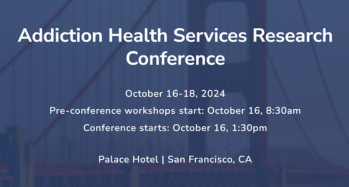
AHSR is still accepting individual presentation and symposium abstracts for innovative and impactful research that moves the field of addiction forward. Abstracts must be submitted by the person who intends to present the study in the case of an individual presentation, and by the chair/moderator in the case of a symposium session. We anticipate that accepted abstracts will be published in a peer-reviewed journal. The deadline for all submissions is Friday, May 10, 2024, at 11:59 PM PT. The AHSR Early Career Investigator Award recognizes scholars with early achievements and exceptional promise for future contributions to addiction health services research. Continuing the tradition of recognizing and supporting the next generation of researchers, we will select up to six awardees to be recognized at the 2024 conference. Each awardee will receive a financial award to help offset conference travel and registration. Deadline to apply for the Early Career Investigator Award is Tuesday, May 21, 2024, at 11:59 PM PT. Find out more about the AHSR conference here!