-
CTN Community Representation Council Meeting Summary (April 2025)
The National Drug Abuse Treatment Clinical Trials Network Community Representative Council (CTN CIRCL) is a collaborative of the national CTN that comes together bi-monthly to courageously share what’s happening in their communities. This summary provides an overview of topics discussed at the April 2025 meeting and is not an exhaustive review. The thoughts and experiences herein are those of CIRCL members and do not represent the National Institute on Drug Abuse or the Clinical Trials Network. The voices empowered by CIRCL are intended to drive research and clinical efforts in the CTN and across the US. The following themes and discussions were highlighted during this meeting: Trends in substance use/public health Methadone needs to be more accessible Job security and supporting the workforce caring for people who use drugs (PWUD) Not all communities are seeing reductions in overdoses Law enforcement strategies are needed Download/print the April meeting summary (pdf)
-
CTN T&I SIG: CTN T&I SIG: Implementation of ED-Initiated Buprenorphine for Opioid Use Disorder (May 20, 2025, 9am PT)
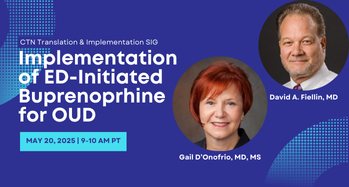
Join the CTN Translation & Implementation (T&I) SIG on May 20, 2025 (9-10am PT) for their next virtual meeting, featuring the work of CTN-0069: Opioid Use Disorder in the Emergency Department (Project ED Health). Presenters Gail D’Onofrio, MD, MS, and David A. Fiellin, MD, will share their study approach and results, as well as considerations for integrating implementation outcome evaluations in efficacy/effectiveness protocols. Read more about the session and presenters here (pdf)! Interested in attending? Reach out to Elena Rosenberg-Carlson (rosenbee@stanford.edu) for the meeting link and/or to join the SIG listserv! Posted on April 30, 2025.
-
Learning for Early Careers in Addiction & Diversity (LEAD Program): Apply by April 15, 2025!
The Learning for Early Careers in Addiction and Diversity (LEAD) program offers mentorship and training to postdoctoral fellows and assistant professors who are pursuing independent research careers in substance use and substance use disorder treatment. This support is aimed at individuals from racial and ethnic minoritized groups who are underrepresented among NIH-funded investigators in this field. The LEAD Program uses the NIDA Clinical Trials Network (CTN) as a platform for training early-careerinvestigators. This 3-year training program is based at the University of California, San Francisco (UCSF), and visiting scholars spend three summers in a 4-week intensive program at UCSF. During the academic year, scholars work with their primary mentor to collaborate on substance use and substance use disorder treatment research conducted in the CTN, develop a professional research network, and conduct a pilot study that will serve as a preliminary study for subsequent NIH funding. The program provides travel and housing funds for scholars, as well as pilot study funding. The 2025 summer program begins on July 7th and ends August 1st. The application deadline is April 15, 2025! Learn more and apply here!
-
News from the Appalachian Node: Updates from the CTN-0139 Co-CARE study
Jane Liebschutz (Appalachian Node), Rebecca Stone (NY Node) and Donna Beers (Boston Medical Center) traveled to Enterprise OR to conduct a site visit at Winding Waters, a federally qualified health center participating in CTN 139-CoCare. The three city slickers enjoyed their first taste of Frontier designation, which is less than 6 people per square mile. The view was stunning with snow capped peaks and a gorgeous river. But what impressed us all was the dedication and smooth running of the clinic. The five physicians and three physician assistants provide primary care, mental health or dental health to 80% of the population in the area. The program joined CTN-139 as part of the Care for Health Initiative, which supports multiple rural primary care research networks around the US. The research team, from both local and more distant locations in Oregon, showed the lead team how coherent leadership and dedication can make a low resourced area function well. We expect them to start patient recruitment by early April at the latest. Also: The Union Community Care site in Lancaster, PA has begun patient recruitment and so far in March have enrolled 6 participants! Posted on March 14, 2025
-
Primary Care SIG Meeting: March 24, 2025 (9-10am PT/12-1pm ET)
The Primary Care SIG aims to engage primary care in research, develop substance use treatment interventions relevant to community-based practice, and promote the transfer of evidence-based results from substance use research into community-based practices. Primary Care SIG Key Objectives Primary Care SIG Webinars and presentations The Primary Care SIG is led by Joe LeMaster, MD, MPH and Sebastian Tong, MD, MPH, and meets every other month on the 4th Monday of the month from 9-10am PT/12-1pm ET. To join the Primary Care SIG webinar series listserv, please provide your contact information here: https://redcap.link/PCSIG Next Primary Care SIG Meeting Implementing Practice Facilitation to Enhance Chronic Pain and Opioid Management in Older AdultsMarch 24, 2025 9-10am PT/12-1pm ET Zsolt Nagykaldi, PhD, BTh Professor, Director of Research Associate Director of Community Engaged Research Department of Family & Preventive Medicine University of Oklahoma Health Sciences Center Juell Homco, PhD, MPH Assistant Professor Director of Research and Community Analytics Associate Director of Oklahoma Primary Healthcare Improvement CooperativeDepartment of Medical Informatics University of Oklahoma School of Community Medicine Heather Gamble, BS Community Outreach Manager (Practice Facilitator) Oklahoma Shared Clinical and Translational Resources University of Oklahoma Health Sciences Center Register for the Primary Care SIG Meeting here Posted on March 14, 2025
-
CTN-0096 (Tribal MOUD): Notice of Data Lock Completion
Culturally Centering Medications for Opioid Use Disorder with American Indian and Alaska Native Communities (CTN-0096, Tribal MOUD) – Notice of Data Lock Completion Incorporating American Indian and Alaska Native (AI/AN) traditional practices and knowledge into healthcare can support AI/AN health. Despite higher rates of abstinence, AI/AN experience the highest rates of overdose mortality due to the ongoing impact of colonization, historical trauma, discriminatory policies, and under-resourced healthcare. Medications for opioid use disorder (MOUD; e.g., buprenorphine, methadone, naltrexone) are the most effective treatment for reducing opioid-related mortality. CTN-0096 (Tribal MOUD) was a two-phase formative implementation study with a stepped wedge design, grounded in community-based participatory research (CBPR) principles, with the aims to develop and test a program-level intervention to culturally center the delivery of MOUD in four healthcare/addiction specialty treatment sites serving AI/AN communities. In Phase I, a Collaborative Board (CB) guided intervention development which was also informed by Indigenous and Western implementation science frameworks. In Phase II, workgroups at each site participated in a six-month intervention delivered in three phases (explore, prepare, implement) and guided by two American Indian facilitators knowledgeable in implementation strategies and clinical best practices. The primary outcome, comparing pre-intervention to post-intervention, was the number of AI/AN clients initiated on to MOUD obtained through program electronic health records. We are delighted to share that CTN-0096 data lock was completed on December 13th, 2024. Preliminary outcomes will be forthcoming. The lead study team sends congratulations and a big thank you to our fantastic community research partners, collaborative…
-
News from the Pacific Northwest Node
The Pacific Northwest Node of the NIDA Clinical Trials Network, located at the UW Addictions, Drug & Alcohol Institute and directed by Mary Hatch, PhD, and John Roll, PhD, had a very productive 2024, with 4 published papers and 4 more in the works! New Publications First, they recently participated in the publication of four papers from CTN-0082, Implementation Survey of PrEP and Opioid Use Related Services in STI Clinics and Community Based Organizations (CBOs), including two outcomes papers (first two listed here): The two outcome papers found that people who use opioids (PWUO) and substance using men who have sex with men (SU-MSM) are both interested in using PrEP. There were distinct factors associated with willingness to use two different types of PrEP formulations: daily oral and long-acting injectable (LAI). For SU-MSM, willingness to use daily oral PrEP was associated with condomless anal sex, less frequent non-injection drug use, and prior PrEP awareness and past use. Willingness to use long-acting injectable PrEP was associated with being Black, identifying as gay, being single, and higher injection drug use. For PWUO, education and condomless vaginal sex was associated with willingness to take daily oral PrEP, while only education predicted willingness to take LAI PrEP. Careful consideration for matching PrEP messaging to the specific audience is needed. PrEP promotion should expand beyond PWUO and SU-MSM to include people who are predominantly heterosexual and polysubstance-using with HIV risk, who were open to both formulations of PrEP. Coming Soon The Node also has…
-
Injectable Buprenorphine: New Factsheets from CTN PNW Node
Buprenorphine is one of three medications (methadone and naltrexone being the other two) approved for use to treat opioid use disorder. It is available as a film or tablet, and more recently as two long-acting extended-release injectables. Sublocade™ was first to be approved by the FDA in November 2017. More recently, in May 2023, Brixadi™ received approval. In January 2024 it was added to the WA state Medicaid formulary. Fewer clinicians have experience using Brixadi™ than Sublocade™. The CTN Pacific Northwest Node recently developed a set of videos intended to aid prescribers in their conversations with patients interested in these buprenorphine options, and have now added two new factsheets too: Injectable Buprenorphine: Getting Started Injectable Buprenorphine: Logistical Info for Clinics Find the complete set of resources here!
-
Youth SIG Webinar: Age, Period, and Cohort Effects in Alcohol and Other Substance Use (Jan 17, 11am ET)
Join the CTN Youth SIG for their next webinar, “Age, Period, and Cohort Effects in Alcohol and Other Substance Use: Implications for Health and Prevention,” presented by Katherine M. Keyes, PhD (Columbia University), on Friday, January 17, 2025, 11am-12pm ET. Incidence, prevalence, and persistence of substance use differ by generation and by substance. Understanding how each generation uses alcohol and other drugs, why, and how health is implicated is critical for public health. The presentation will overview what we know about current trends in substance use, how rates are organized by age, period, and cohort, and how these trends are shaping public health overall. About the presenter Katherine M. Keyes, PhD, is Professor of Epidemiology at the Columbia University Mailman School of Public Health. Dr. Keyes’ research focuses on psychiatric and substance use epidemiologyacross the life course, including early and cross-generational origins of child and adult health and cohort effects on substance use, mental health, and injury outcomes including suicide and overdose. She is the author of more than 450 peer-reviewed publications, and two textbooks. Register here!
-
Recording available: NIDA CTN: Future of AI in Medicine: Medical Imaging as an Example
A recording of this webinar, held on November 20, 2024, is now available! (passcode: N7A3h^SX) Presenter:Dr. Curt LanglotzProfessor of Radiology, Medicine, and Biomedical Data ScienceSenior Associate Vice Provost for ResearchDirector, Center for Artificial Intelligence in Medicine & ImagingSenior Fellow, Institute for Human-Centered Artificial Intelligence Artificial intelligence (AI) is an incredibly powerful tool for building systems that support the work of clinicians and researchers. Over the last decade, machine learning methods have revolutionized the analysis of medical data, leading to high interest and explosive growth in the use of AI and machine learning methods. These promising techniques create systems that perform some clinical tasks at the level of expert physicians. Deep learning methods in imaging are now being developed for image reconstruction, imaging quality assurance, imaging triage, computer-aided detection, computer-aided classification, and radiology report drafting. The systems have the potential to provide real-time assistance to radiologists and other imaging professionals, thereby reducing diagnostic errors, improving patient outcomes, and reducing costs. We will review the origins of AI and its applications to medicine, and medical imaging, define key terms, and show examples of real-world applications that suggest how AI may change the practice of medicine. We will also review key shortcomings and challenges that may limit the application of these new methods. About the presenter Curtis P. Langlotz, MD, PhD : Dr. Langlotz is Professor of Radiology, Medicine, and Biomedical Data Science, and Senior Associate Vice Provost for Research at Stanford University. His NIH-funded laboratory develops machine learning methods to improve the accuracy and…